
Table of Contents
- Celebrity Case Studies
- Understanding the Legal Framework
- The New Risks
- The Contractual Trap: How Rights Are Often Licensed Away
- A Strategic Approach To Protect Identity
- The Future of NIL
- Related Questions & Answers
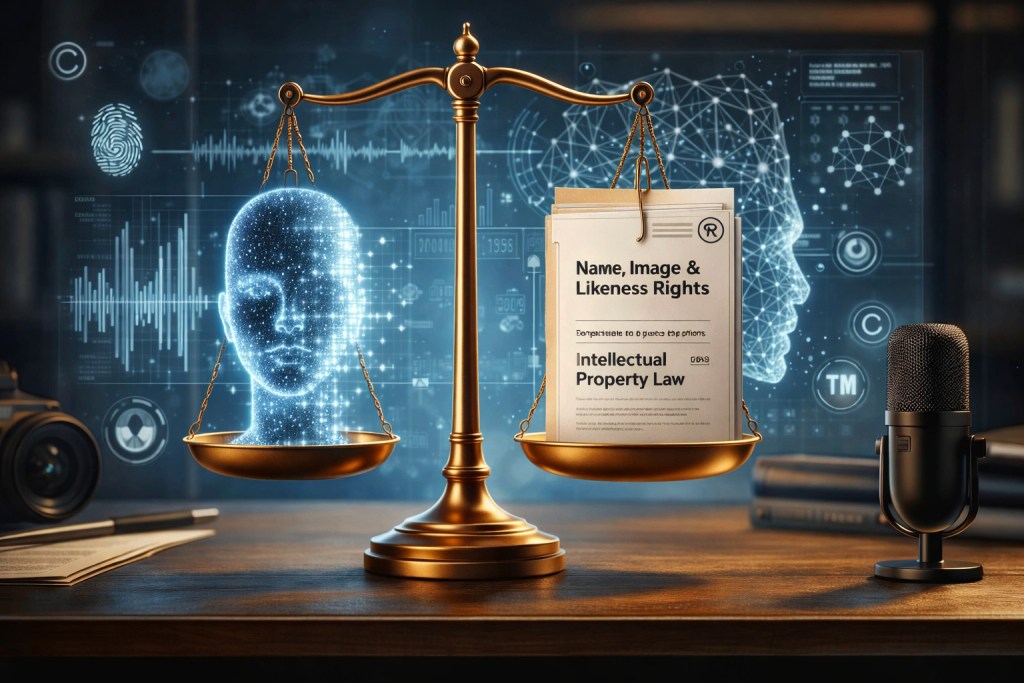
Artificial intelligence is rapidly transforming the legal meaning of identity. Modern generative AI systems can replicate voices, facial expressions, and performance styles with extraordinary realism, raising complex questions about who owns and controls a person’s likeness.
This article explores the intersection of artificial intelligence and intellectual property law, the emerging risks created by synthetic media, and the legal strategies individuals and businesses should consider to maintain control over their name, image, and likeness.
1. Celebrity Case Studies
Recent events involving well-known public figures have brought these questions into the legal spotlight:
- Actress Scarlett Johansson raised concerns in 2024 after a voice used by ChatGPT appeared strikingly similar to her own, despite her declining an offer to license it; OpenAI ultimately removed the voice model following objections from Johansson and her legal team (Benesch).
- Similarly, actor Tom Hanks warned fans about a circulating advertisement that used an AI-generated version of his likeness to promote a dental plan without his consent, publicly stating that he had “nothing to do with it” and highlighting the growing misuse of synthetic media in commercial contexts (ABC News).
- Actor Matthew McConaughey recently secured multiple trademark registrations covering elements closely associated with his persona, including a sound mark for his iconic phrase “alright, alright, alright,” establishing a federal trademark basis to challenge unauthorized commercial uses, including potential AI-generated replicas (People).
These developments illustrate a broader reality: in a digital economy driven by artificial intelligence, identity itself has become a valuable form of intellectual property.
2. Understanding the legal framework
Protecting identity in the age of AI requires understanding the primary legal frameworks that govern intellectual property in the United States: copyright law, trademark law, and the right of publicity.
Copyright law protects original works of authorship fixed in a tangible medium, including photographs, films, recordings, scripts, and other creative works. Importantly, copyright does not protect a person’s identity itself—a face or voice cannot be copyrighted in the abstract—but protects the creative works that capture or depict those elements. This distinction becomes particularly relevant as AI systems are trained on large datasets that may contain copyrighted media, potentially providing an avenue for enforcement when generative models produce derived outputs.
Related: Breaking Down the Intersection of Right-of-Publicity Law, AI
Trademark law addresses consumer confusion, protecting identifiers like names, slogans, logos, and distinctive branding that signal the source of goods or services; for public figures, it can prevent unauthorized uses implying endorsement or affiliation. Finally, the right of publicity provides the most direct protection for name, image, and likeness, prohibiting unauthorized commercial exploitation, though its scope varies by state.
Several court decisions have shaped the doctrine.
- Midler v. Ford Motor Co. (1988): The court held that deliberately imitating singer Bette Midler’s distinctive voice in a commercial could constitute a violation of her right of publicity after she declined to participate in the advertisement.
- White v. Samsung Electronics America (1993): An advertisement featuring a robot styled to resemble television personality Vanna White was found potentially liable for misappropriating her identity, even though she did not personally appear in the ad.
- Carson v. Here’s Johnny Portable Toilets (1980): The court determined that the use of the phrase “Here’s Johnny”—strongly associated with television host Johnny Carson—could violate his publicity rights despite the absence of his name or likeness.
These cases demonstrate that courts protect recognizable elements of identity even when indirectly referenced, a complexity amplified by AI-generated synthetic media.
3. the new risks
Artificial intelligence has dramatically changed the landscape of identity misuse. Historically, replicating a person’s likeness required significant resources like casting look-alikes or video manipulation; today, generative AI recreates voices, facial expressions, and speech patterns with minimal effort.
The implications are significant.
- AI lowers the barrier to entry: Convincing voice clones or digital avatars require little technical expertise.
- AI enables massive scale: A single trained model can produce unlimited variations, like thousands of recordings from one voice.
- Distribution happens instantly: Content spreads across social media to millions before legal remedies.
- AI raises market dilution concerns: Indefinite replication erodes the scarcity value of endorsements.
The experience of Tom Hanks illustrates this risk. For actors, athletes, influencers, and public figures, the issue is economic—identity as a monetizable asset that AI replicates at scale.
4. the contractual trap
Despite growing attention to deepfakes, the greatest risks to name, image, and likeness often stem from contractual agreements in entertainment, advertising, sports, and tech. These frequently include sweeping language like “in perpetuity,” “worldwide,” or “in all media now known or hereafter devised,” standard in licensing but transformative in the AI era.
For example:
- A voice recording might enable permanent AI voice models.
- Facial scans from films could be reused indefinitely in digital environments.
- Motion-capture data might train AI for new performances.
These concerns fueled recent entertainment labor negotiations between actors and studios. Careful drafting is essential, defining digital replicas, AI training data use, synthetic performances, and reuse compensation to avoid unintentionally licensing identity longer than intended.
5. A Strategic Approach To Protect Identity
Arm your defenses against AI threats with these battle-tested strategies:
- In the fast-evolving AI arena, safeguarding your name, image, and likeness demands a multi-layered fortress. Start with trademarks—McConaughey’s savvy sound mark for “alright, alright, alright” weaponizes federal law against rogue replicas.
- Bolster with copyright on photos, videos, and performances capturing your essence. Craft ironclad contracts specifying no-go zones for digital clones, synthetic voices, AI training, and derivatives.
- Strike fast: unleash trademark takedowns, DMCA notices, and platform flags to outpace viral deepfakes. Consider guidance from specialized IP attorneys like Alexander R. Karana, Esq., a USPTO-licensed expert helping entertainers and innovators protect and monetize identity in disruptive tech landscapes.
6. the future of nil
Artificial intelligence is beginning to reshape not only media and entertainment, but also the legal and economic value of personal identity. As generative technologies become capable of replicating voices, facial expressions, and performance styles, the concept of name, image, and likeness (NIL) is expanding into the digital economy.
Some lawmakers have already begun addressing these risks. In the United States, the ELVIS Act—currently in force in the state of Tennessee—specifically extends publicity rights to protect against unauthorized AI-generated imitations of a person’s voice. At the federal level, the proposed NO FAKES Act seeks to establish nationwide protections against the creation and distribution of unauthorized digital replicas of individuals. While the bill aims to address the growing risks posed by AI-generated deepfakes, some legal scholars—including Jennifer E. Rothman—have argued that the current draft may still require significant revisions to ensure that individuals retain meaningful control over their digital likeness and that the law does not unintentionally favor large technology platforms or content distributors.
Recent legal scholarship has highlighted the broader regulatory shift prompted by synthetic media and deepfakes. As AI technologies blur the line between authentic and fabricated content, legal systems are increasingly responding through three emerging pillars: intellectual property and digital personality rights, the protection of personal dignity—particularly in cases of non-consensual deepfakes—and safeguards for democratic integrity through transparency requirements for AI-generated content. These developments suggest a growing consensus that identity in the digital age is not merely a personal attribute but an asset requiring clear legal protection and governance (Synthetic Media and Deepfakes: Legal Responses to Identity, Dignity and Truth in the Age of AI, 2026).
The rules around AI, digital identity, and NIL are changing faster than most people realize. The individuals and organizations who understand how to protect and structure their rights today will be the ones who control their identity tomorrow. If you want clarity on how these developments affect you, your brand, or your business, reach out and start the conversation.
7. related Questions & answers
- What are Name, Image, and Likeness (NIL) rights?
Name, Image, and Likeness (NIL) rights allow individuals to control and monetize the commercial use of their identity, including their name, voice, appearance, or recognizable persona. - Are AI-generated deepfakes illegal?
AI-generated deepfakes are not always illegal, but they can violate laws related to the right of publicity, trademark infringement, fraud, or defamation, particularly when they falsely suggest endorsement or misuse someone’s identity. - What is the ELVIS Act?
The ELVIS Act is a Tennessee law enacted in 2024 that expands publicity rights to protect individuals from unauthorized AI-generated imitations of their voice, image, or likeness, particularly in music and entertainment. - What is the NO FAKES Act?
The NO FAKES Act is a proposed federal law designed to create nationwide protections against the unauthorized creation and distribution of AI-generated digital replicas of individuals. - How can individuals protect their identity from AI misuse?
Individuals can protect their identity by using trademark registrations, copyright protection, carefully drafted contracts, and enforcement strategies such as takedown notices and right-of-publicity claims.
About the Author
Alexander R. Karana is an Intellectual Property and International attorney at Cummings, McClorey, Davis & Acho, PLC (CMDA), admitted to practice in Michigan, Illinois, and before the United States Patent and Trademark Office. He focuses on patent and trademark prosecution, IP strategy, and entertainment law. Alexander has been recognized by Best Lawyers: Ones to Watch in America and Super Lawyers: Rising Stars for his work in IP and Sports & Entertainment law.
Alexander helps inventors, entrepreneurs, and online brands protect and monetize innovation through patent and trademark prosecution, strategic IP enforcement, and commercial transactions.
Contact: AKarana@cmda-law.com | 17436 College Parkway, Livonia, MI 48152
Legal Disclaimer: This article is for informational purposes only and does not constitute legal advice. Reading it or contacting the author does not create an attorney–client relationship. Each case is unique; consult a qualified attorney for your specific situation.