

Table of Contents
- Introduction
- The Business Behind College Sports
- Mascots, Colors, and Trademarked Identity
a. The scope of trademark protection is expanding. - The NCAA and the Power of “March Madness”
- When Rivalries Turn Legal: The “Buckeye Tears” Case
a. Case Background
b. Ohio State’s Legal Arguments
c. Trademark Law vs. Cultural Expression
d. Current Status - The Fight for Brand Control
- FAQ
1. Introduction
College sports have long been a source of passion across the United States, from intense football Saturdays to the nationwide excitement of March Madness. As someone connected to Michigan State University, that energy feels especially real—whether it’s the atmosphere around Spartans football in the fall or basketball season bringing people together. That same passion extends beyond campus into Detroit sports, where teams like the Detroit Lions and Detroit Pistons are a constant presence. But these events are not only cultural phenomena; they are also major commercial enterprises.
March Madness, for example, generates close to $1 billion annually through broadcasting rights and licensing agreements, attracting millions of viewers whose engagement drives advertising revenue and merchandise sales. This scale of economic activity makes college athletics one of the most commercially significant sectors in sports.
To understand how this system functions, it is essential to look beyond the games themselves and focus on trademarks. These legal tools allow universities and organizations like the NCAA to control how their brands are used. In practical terms, trademarks ensure that when fans encounter a team name, logo, or slogan, they can trust its origin and authenticity. Without such protection, third parties could freely exploit these identities, creating confusion and weakening the value of established brands.
2. The Business Behind College Sports
At its core, college sports branding follows a structured process. Universities develop recognizable identities—team names, logos, slogans, and visual elements—that resonate with fans. These identities are then monetized through licensing agreements, merchandise sales, sponsorships, and media exposure.
This model applies across major college sports—particularly football and basketball—where large audiences and strong fan engagement translate into significant commercial value. While the same principles extend to other sports, their economic impact and level of trademark enforcement tend to be more limited.
The scale of this system is substantial. Collegiate licensing represents a multi-billion-dollar industry, exceeding $4 billion annually, with apparel accounting for a significant share of total sales. Products such as jerseys, hats, and branded clothing rely directly on protected trademarks to maintain their authenticity and value (Rawshot.AI).
Trademark law plays a central role in enabling this system. By registering their marks with the United States Patent and Trademark Office (USPTO), universities obtain exclusive rights to use and license their brand elements. In practice, this means they can prevent unauthorized parties from producing similar goods or using confusingly similar branding.
3. Mascots, Colors, and Trademarked Identity
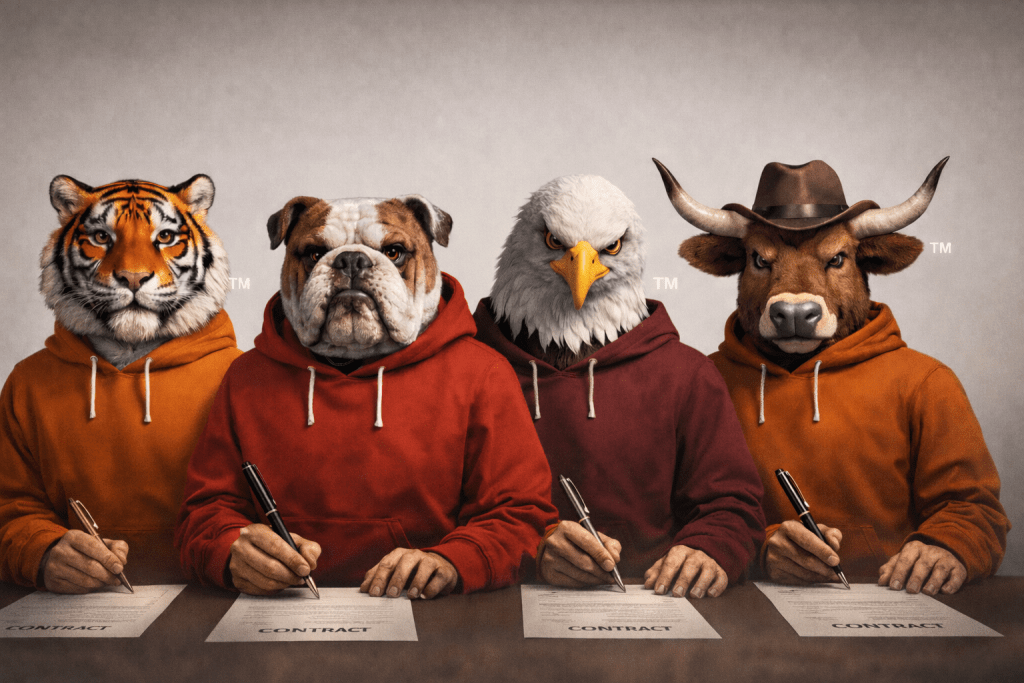
Trademark protection in college sports extends far beyond team names and logos. Universities also protect mascots, color schemes, and thematic elements that together form a recognizable identity.
Mascots, for example, are not merely symbolic. Through consistent use in merchandise, marketing, and media, they become closely associated with a specific institution and can function as trademarks. Well-known examples include the Oregon Ducks, the Georgia Bulldogs, and the Texas Longhorns, whose imagery is widely licensed across commercial products.
Color schemes play a similarly important role, although their protection is more nuanced. While a single color is rarely sufficient, distinctive combinations can acquire legal significance. Michigan State’s green and white, Ohio State’s scarlet and gray, and Alabama’s crimson and white can immediately signal a university’s identity, even without a logo.
In some cases, branding extends into distinctive visual traditions. Michigan State’s “Spartan” identity, Penn State’s “White Out”, and North Carolina’s “Carolina Blue” show how design elements and fan-driven traditions become part of a school’s commercial identity
a. The scope of trademark protection is expanding
Universities are increasingly concerned not only with direct uses of their logos, but also with how their identity is referenced, adapted, or even parodied in the marketplace. The “Buckeye Tears” dispute demonstrates how a rivalry-based expression—without official branding—can still raise trademark concerns when it draws on a recognizable identity.
This expansion is also visible in new commercial contexts. The rise of Name, Image, and Likeness (NIL) has introduced athlete-specific merchandise and digital branding opportunities, while collaborations and social media have created new spaces where university identity is used and contested.
Related: AI & Celebrity NIL: An Intellectual Fight to Protect Real Identities
From a trademark perspective, what is being protected is not just a symbol, but the association built in the minds of consumers. Mascots, colors, phrases, and cultural references all function as indicators of source.
In this sense, college sports trademarks are evolving from static identifiers into dynamic brand ecosystems. Universities are not only protecting logos—they are protecting meaning, and increasingly, the broader cultural space in which that meaning operates.
4. The NCAA and the Power of “March Madness”
At a broader level, the National Collegiate Athletic Association (NCAA) plays a central role in managing the intellectual property associated with college athletics. It owns trademarks for key tournament-related terms such as “March Madness,” “Final Four,” and “Elite Eight,” which are essential to its commercial strategy.
These trademarks allow the NCAA to tightly control how the tournament is used in the marketplace. Businesses, for example, cannot freely use “March Madness” in advertising without authorization, often resorting to indirect expressions like “the big tournament.” This ensures that the economic value of the event remains with official partners.
The scale of this value becomes clearer in light of an S&P Global article, “March Madness returns with current media deals in place through 2032,” which highlights three key factors:
- Long-term media value
The NCAA men’s tournament media deal is worth nearly $9 billion through 2032, generating close to $1 billion annually. - Massive audience reach
Recent tournaments have averaged around 9 million viewers in early rounds, with championship games exceeding 18 million viewers. - An expanding commercial ecosystem
Millions of fans participate through brackets, billions of dollars are wagered on tournament games, and the women’s tournament continues to grow in viewership and media value.
Taken together, these elements explain why trademark enforcement is so strict. The NCAA is not simply protecting terminology—it is safeguarding a multi-billion-dollar ecosystem built on visibility, engagement, and long-term media rights. In effect, it does not just organize the tournament; it controls the language and commercial framework through which it is experienced.
5. When Rivalries Turn Legal: The “Buckeye Tears” Case

The role of trademarks becomes particularly visible when it intersects with one of the most well-known rivalries in college sports: The Ohio State University v. The Brown Jug, Inc.
a. Case Background
In 2025, Ohio State filed a notice of opposition with the USPTO against a Michigan-based restaurant, The Brown Jug, which sought to trademark the phrase “Buckeye Tears” for beer and liquor products.
The phrase draws directly from rivalry culture, referencing Ohio State’s “Buckeyes” in a humorous and provocative way. The application was filed on an “intent to use” basis, meaning the product had not yet been widely commercialized and had only appeared in limited contexts without official university logos or branding.
This context is important. The Ohio State–Michigan rivalry, one of the most storied in U.S. sports, creates a cultural environment where such expressions are common. However, once these expressions move into the marketplace, they may also fall within the scope of trademark law. This shift—from cultural expression to commercial use—sets the stage for the legal dispute.
b. Ohio State’s Legal Arguments
From a legal perspective, the dispute centers on two main concerns.
- Ohio State argues that the phrase could create consumer confusion, meaning that buyers might mistakenly believe the product is affiliated with or endorsed by the university. This concept—known as the “likelihood of confusion”—is a cornerstone of trademark law and often determines whether a mark can be registered or used.
- The university raises concerns about brand dilution and reputational harm, particularly due to the association with alcohol. Given the scale of its licensing program—reportedly generating over $145 million in royalties and approximately $2.2 billion in retail sales over the past decade—Ohio State has a strong incentive to control how its brand is used and perceived in the marketplace (CBS Sports).
c. Trademark Law vs. Cultural Expression
At the same time, one might question whether “Buckeye Tears” would actually confuse consumers. In context, it seems more like a tongue-in-cheek reference to a historic rivalry than an official product.
This raises a broader issue: how far should trademark protection go when it intersects with fan culture? Rivalries, humor, and parody are central to the college sports experience, yet they often rely on the same identities that trademarks aim to control.
Ultimately, the challenge lies in deciding where expression ends and infringement begins.
d. Current Status
As of early 2026, the dispute remains unresolved, with proceedings potentially extending over several years. Regardless of its outcome, the case provides a clear illustration of how trademark law operates in practice.
More importantly, it demonstrates how far trademark enforcement can extend—reaching beyond logos and names into the broader cultural use of a university’s identity. Universities are no longer focused solely on preventing direct copying; they are increasingly attentive to how their brands are referenced, interpreted, and even challenged in commercial contexts (Ohio State Buckeyes).
6. More Than a Game
What begins as school spirit—team names, colors, mascots, and rivalries—quickly evolves into something far more valuable. These elements drive merchandise sales, media deals, sponsorships, and fan engagement at a national scale. As their economic importance grows, so does the need to control how they are used.
Trademark law has become the mechanism that makes this control possible. It allows universities and organizations like the NCAA to define who can use their identity, in what context, and for what purpose. Whether through licensing agreements, enforcement actions, or high-profile disputes like “Buckeye Tears,” institutions are continuously shaping the boundaries of their brand.
This dynamic is not unique to universities. As explored in “AI & Celebrity NIL: An Intellectual Fight to Protect Real Identities”, similar challenges are emerging in the context of individual identity, where public figures increasingly rely on intellectual property tools to control how their name, image, and likeness are used in digital and commercial environments.
In this sense, college sports operate at the intersection of competition and commerce. Games may determine winners on the scoreboard, but trademarks determine who controls the meaning—and ultimately the value—behind those wins.
7. FAQ
1. Why is “March Madness” trademarked?
The NCAA owns the trademark to control how the term is used commercially. This ensures that the tournament’s massive economic value—driven by media rights, sponsorships, and advertising—remains tied to official partners.
2. What was the “Buckeye Tears” case about?
Ohio State opposed a Michigan-based business’s attempt to trademark “Buckeye Tears,” arguing it could create confusion and harm its brand. The case highlights how even rivalry-based or humorous expressions can raise legal questions when used in a commercial context.
3. How do trademarks turn college sports into real business assets?
Trademarks give universities legal control over the names, logos, colors, and phrases that fans associate with their programs. That control allows schools to license apparel, authorize branded products, structure sponsorship deals, and protect the exclusivity that gives those relationships value. Without trademark protection, it would be much harder for universities to maintain a consistent brand or capture the commercial value tied to fan loyalty.
4. What happens if someone uses a college brand without permission?
They may face legal action, including cease-and-desist letters, licensing disputes, or formal proceedings before the USPTO. The outcome often depends on whether the use creates consumer confusion or improperly exploits the brand.
5. Where is the line between fan expression and trademark infringement?
This is one of the most debated questions in trademark law. While fan culture often includes parody, humor, and rivalry-based expressions, problems arise when those uses enter the marketplace and begin to look like official or endorsed products.
About the Author
Alexander R. Karana is an Intellectual Property and International attorney at Cummings, McClorey, Davis & Acho, PLC (CMDA), admitted to practice in Michigan, Illinois, and before the United States Patent and Trademark Office. He focuses on patent and trademark prosecution, IP strategy, and entertainment law. Alexander has been recognized by Best Lawyers: Ones to Watch in America and Super Lawyers: Rising Stars for his work in IP and Sports & Entertainment law.
Alexander helps inventors, entrepreneurs, and online brands protect and monetize innovation through patent and trademark prosecution, strategic IP enforcement, and commercial transactions.
Contact: AKarana@cmda-law.com | 17436 College Parkway, Livonia, MI 48152
Legal Disclaimer: This article is for informational purposes only and does not constitute legal advice. Reading it or contacting the author does not create an attorney–client relationship. Each case is unique; consult a qualified attorney for your specific situation.