March Madness NIL and trademark strategy is becoming increasingly important as college basketball’s biggest tournament puts athletes on a national stage. Each year, players go from relative anonymity to widespread recognition in just a few games.
For athletes, families, and sports agents, that visibility creates real opportunity—but also important decisions. As exposure grows, so does the value of a player’s name, image, and performance, along with the legal and branding considerations that come with it.
This article explains not only how the tournament works, but how to approach it strategically—turning a short-term moment into a long-term opportunity through smart branding, NIL awareness, and trademark protection.
Table of Contents
-
- Understanding March Madness
- How Teams Reach the Tournament
-
- The Final Four: Maximum Exposure
- March Madness NIL and Trademark Strategy for Athletes
a. Personal Identity vs. Institutional Branding
b. NIL Opportunities and Trademark Boundaries
c. Where Risk Emerges
d. Trademark Enforcement in Practice
e. USPTO: Turning Visibility Into Long-Term Value
-
- Final Perspective
-
- Q&A: What You Need to Know
1. March Madness NIL and trademark strategy: Context
March Madness is a 68-team, single-elimination tournament. Each team plays until it loses once—after which it is eliminated.
As teams advance:
-
- Games receive more attention
- Media coverage increases
- Player and team visibility grows
Because of this structure, even lesser-known programs—and their athletes—can quickly become part of the national spotlight.
For athletes, this means that your exposure can increase dramatically in a very short period of time.
2. How Teams Reach the Tournament
Teams enter March Madness through two main paths:
-
- Automatic qualification (32 teams): by winning their conference tournaments.
- At‑large selection (36 teams): chosen by a committee based on overall performance, strength of schedule, and other metrics.
Once selected, teams are ranked (or “seeded”) and placed into a bracket. While higher‑seeded teams are expected to perform better, surprises are common.
Unexpected teams often advance deep into the tournament, meaning athletes who were not widely known can suddenly gain significant visibility and commercial attention. This kind of rapid exposure is not theoretical. In past tournaments, players such as Stephen Curry and Ja Morant used March Madness as a breakout stage: they arrived as promising college athletes, but standout performances in high‑profile games turned them into national stars virtually overnight and significantly expanded their professional opportunities.
Source: Clutch Points, “Stephen Curry’s March Madness iconic moments, history at Davidson”
Source: ESPN, “Inside Ja Morant’s NCAA tournament star turn”
More recently, in 2022, the Saint Peter’s Peacocks—a No. 15 seed—advanced to the Elite Eight, generating widespread national attention and significant social media visibility. Players such as Doug Edert became recognizable figures almost overnight. Under today’s Name, Image, and Likeness (NIL) rules, that sudden exposure can translate into endorsement deals, social media partnerships, and other monetized opportunities for student-athletes, even if their team does not reach the Final Four or win the national championship.
Source: Los Angeles Times, “Saint Peter’s March Madness run made an everlasting impact on the sports world”
Related: AI & Celebrity NIL: An Intellectual Fight to Protect Real Identities
3. The Final Four: Maximum Exposure
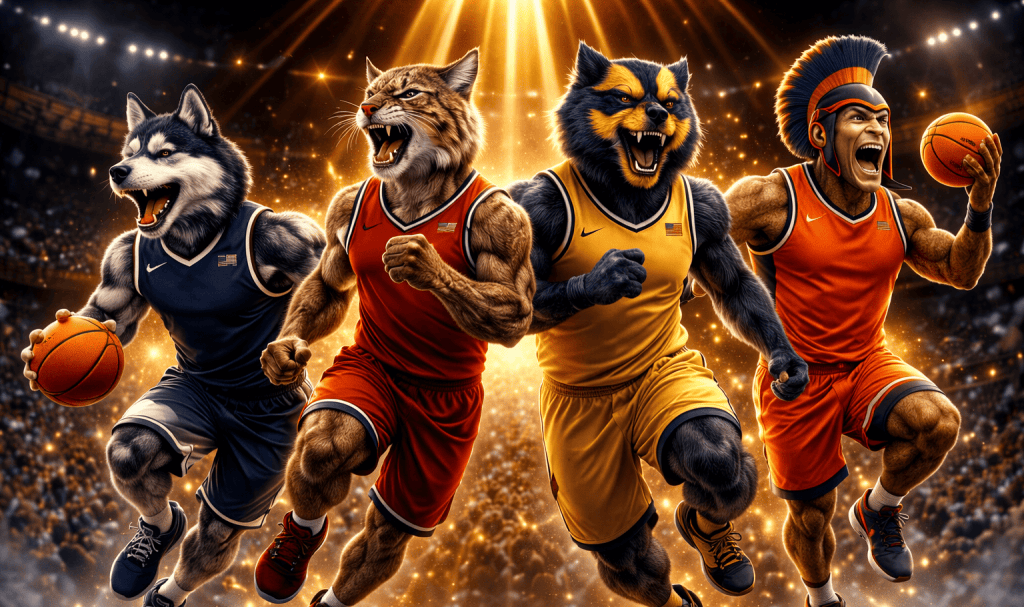
The Final Four is the semifinal stage of March Madness—where only four teams remain after surviving a month of high‑pressure wins and narrow escapes. In 2026, those teams are:
- Arizona Wildcats: Arizona entered as a high‑seeded favorite and advanced through the Sweet 16 and Elite Eight with a balanced, guard‑driven offense and strong perimeter shooting, proving they could handle the national spotlight under pressure.
- Michigan Wolverines: Michigan earned its spot through a gritty, defense‑first approach, grinding out close games and relying on rebounding and disciplined shot selection to survive tough matchups.
- UConn Huskies: UConn returned to the Final Four as a seasoned tournament program, using its veteran‑heavy roster and fast‑paced, transition‑oriented offense to knock out higher‑seeded opponents.
- Illinois Fighting Illini: Illinois made a deep run powered by an explosive offense and dramatic late‑game wins, capturing fan attention and reminding viewers of the program’s national‑stage pedigree.
Related: “March Madness 2026: What teams are in the Final Four?
At this point, visibility is at its peak:
- National broadcasts reach tens of millions of viewers across TV and streaming platforms.
- Team branding is everywhere—from jerseys and arena signage to social‑media highlights and fan‑market merchandise.
- Players on the court begin to attract outside attention from brands, agents, and sponsors looking to capitalize on their moment in the spotlight.
This is where athletic performance and personal brand opportunities begin to intersect. Every made shot, every highlight, and every postgame interview can ripple beyond the tournament and into long‑term NIL‑driven opportunities.
4. March Madness NIL and Trademark Strategy for Athletes
The visibility created during March Madness—especially in later rounds like the Final Four—does not end when the game is over. In many cases, it marks the beginning of something else: the transition from athlete to brand.
As exposure increases, so does the commercial value associated with a player’s name, image, and performance. What begins as recognition quickly turns into marketability, and that shift introduces a legal dimension that is often overlooked in the moment.
Related: “College Sports Trademark Battles: From Rivalries to Courtrooms & Brand Control”.
a. Personal Identity vs. Institutional Branding
At the center of this transition is a distinction that becomes increasingly important: the difference between an athlete’s personal identity and the university’s brand.
Universities own and control their trademarks, including team names, logos, uniforms, and overall visual identity. These elements are not just symbolic—they are protected assets used across media, merchandising, and commercial partnerships.
At the same time, athletes are building their own identity through performance, personality, and public exposure. While these two identities are closely connected in the public eye, they are legally separate. That separation is what defines what can—and cannot—be done as visibility grows.
b. NIL Opportunities and Trademark Boundaries
The introduction of Name, Image, and Likeness (NIL) rights has created meaningful opportunities for athletes to monetize that visibility. Endorsements, social media partnerships, and personal branding initiatives are now part of the college sports landscape.
However, NIL operates within an existing legal framework. It allows athletes to capitalize on who they are, but it does not extend to assets owned by the university.
In practical terms, this means:
- An athlete can promote a product using their name, image, and reputation
- But cannot freely use official team logos, uniforms, or branding without authorization
This distinction is simple in theory, but it becomes more complex in practice—especially during moments of peak exposure.
c. Where Risk Emerges
Legal risk in this space does not usually arise from intentional misuse. More often, it stems from a misunderstanding of how trademark law applies in fast-moving, high-visibility environments like March Madness.
At its core, trademark law is concerned with a single question: whether a given use could create a likelihood of confusion. In practical terms, this means asking whether the public might reasonably believe that a product, promotion, or message is affiliated with—or endorsed by—a university, team, or event when no such relationship exists.
As exposure increases, so does the risk of crossing that line. This is because visibility amplifies perception: what might go unnoticed at another time can take on a very different meaning when millions of viewers are watching and engaging with related content.
In that context, risk typically emerges in situations such as:
- Incorporating team-related visuals or apparel into endorsement content
- Developing branding that closely resembles existing team or event identities
- Referencing the tournament or team success in a way that suggests association
- Not all uses are treated equally. One of the key factors in assessing risk is distinctiveness—how unique and recognizable a particular name or brand is. The more distinctive a mark, the stronger its protection tends to be, and the more actively it is enforced.
This is particularly evident in the case of the NCAA, which closely monitors the use of terms such as “March Madness®” and “Final Four®.” For example, a California car dealership once promoted its sales event using the phrase “Markdown Madness,” which led to a dispute based on the likelihood that consumers would associate the promotion with the NCAA tournament. The matter ultimately resulted in a legal challenge and was resolved out of court.
Source: Broadcast Law Blog: “Risks of Using or Accepting or Engaging in Advertising or Promotions that Use FINAL FOUR or Other NCAA Trademarks”.
Similar issues can arise with variations or imitations—such as “April Madness” or “Final 3”—where phonetic or conceptual similarities may be enough to create confusion, especially during the tournament season when public attention is at its peak.
Understanding how and why these risks emerge is essential. In most cases, the issue is not the intent behind the use, but the impression it creates.
Related: “March Madness: Navigating NCAA’s Trademark Enforcement Playbook”
d. Trademark Enforcement in Practice
Trademark protection in the context of college sports is not merely theoretical—it is actively enforced, often in real time and at moments of peak public attention. Within any effective March Madness NIL and trademark strategy, understanding how enforcement operates is critical, particularly as visibility and commercial stakes increase during the tournament.
The NCAA, in particular, maintains a consistent enforcement posture around its core marks, including “March Madness®,” “Final Four®,” and related tournament identifiers, which anchor a significant commercial ecosystem across media, sponsorships, and licensing.
A recent example illustrates how this enforcement operates. In March 2026, the NCAA filed a federal lawsuit against DraftKings alleging trademark infringement based on the use of terms such as “March Madness,” “Final Four,” “Elite Eight,” and “Sweet Sixteen” within its sports betting platform and promotional materials. The NCAA argued that this use—especially during the tournament—capitalized on its goodwill and created a likelihood of consumer confusion as to affiliation or endorsement. DraftKings, in response, asserted a fair use defense, claiming the terms were used descriptively to identify tournament events.
Source: CBS News, “NCAA accuses DraftKings of “March Madness” trademark infringement, asks court for restraining order”.
This dispute highlights a key principle: trademark law does not prohibit all use of recognizable terms, but it does restrict uses that create misleading commercial impressions. The analysis is highly context-dependent—timing, presentation, and commercial setting all shape how a use is perceived. What may be acceptable in one context can become problematic in another, particularly when visibility is high.
For athletes implications are practical. Branding decisions—across endorsements, social media, and personal ventures—must be evaluated not only for marketability, but for the impression they create. The issue is not just intent, but perception.
Understanding how trademark rights are enforced in practice reinforces a broader point: visibility amplifies risk, and legal boundaries become more consequential as commercial value increases.
e. USPTO: Turning Visibility Into Long-Term Value
What determines whether March Madness exposure becomes a lasting opportunity is not visibility alone, but how it is managed. A personal brand only has real value if it can be used and protected without legal conflict.
In trademark law, this comes down to availability. Before investing in a name, slogan, or brand, it is essential to confirm that it is not already in use or too similar to an existing mark. This is where the United States Patent and Trademark Office plays a central role.
The USPTO maintains the official database of registered trademarks, accessible through its search platform at the Trademark Electronic Search System, or TESS). This tool functions as the primary reference point for determining whether a proposed brand is legally viable. It allows users to identify not only identical marks, but also similar names, phrases, or concepts that could raise concerns under the likelihood of confusion standard.
Understanding how to use this resource—at least at a basic level—is critical. It helps prevent conflicts, informs better branding decisions, and ensures that the value created through exposure can actually be captured and protected.
In that sense, Trademark Search is not just a database—it is the starting point for turning short-term visibility into a sustainable, defensible brand.
5. Strategic Takeaways
March Madness is more than a tournament—it is a moment of acceleration. In just a few games, performance can turn into national visibility and, quickly, into opportunity, underscoring the importance of a well-defined March Madness NIL and trademark strategy.
But that opportunity is only as valuable as the decisions that follow.
At its core, the strategy behind this moment is not simply to take advantage of exposure, but to structure it in a way that creates lasting value. What happens during the tournament generates attention; what is done immediately after determines whether that attention becomes something sustainable.
For athletes, this means understanding that recognition is just the beginning. How you manage your name, image, and brand in that moment can shape future opportunities.
For families, it is about approaching sudden attention with perspective, knowing that not every opportunity is the right one.
For agents, it represents a critical window to build strategies that extend beyond short-term visibility.
Across all perspectives, one principle stands out: visibility only becomes lasting value when it is properly managed and protected. That includes understanding legal boundaries, separating personal identity from institutional branding, and taking practical steps—such as verifying brand availability through the United States Patent and Trademark Office database—to ensure that what is being built can be developed over time.
Ultimately, the advantage does not come from exposure alone, but from knowing what to do with it.
6. Q&A: What You Need to Know
1. Can I use my team’s logo in a personal endorsement deal?
Generally, no. Team logos, uniforms, and branding are owned by the university and cannot be used without authorization, even if you are a player on the team.
2. What does NIL actually allow me to do?
NIL allows you to profit from your name, image, and likeness—such as signing endorsement deals, promoting products, or building a personal brand—so long as you do not use protected team or NCAA trademarks without permission.
3. Why is “likelihood of confusion” important?
Because trademark law focuses on perception. If your content or branding makes people think there is an official connection with a team or the tournament when there isn’t, it may create legal risk.
4. How can I check if a brand name is available?
You can search existing trademarks through the United States Patent and Trademark Office using its online database at tmsearch.uspto.gov. This helps identify potential conflicts before you invest in a name.
5. Do I need to think about trademarks this early?
Yes. The earlier you consider branding and trademark issues, the easier it is to avoid conflicts and build something that can grow with your career.
About the Author
Alexander R. Karana is an Intellectual Property and International attorney at Cummings, McClorey, Davis & Acho, PLC (CMDA), admitted to practice in Michigan, Illinois, and before the United States Patent and Trademark Office. He focuses on patent and trademark prosecution, IP strategy, and entertainment law. Alexander has been recognized by Best Lawyers: Ones to Watch in America and Super Lawyers: Rising Stars for his work in IP and Sports & Entertainment law.
His practice includes intellectual property law with a focus on patent and trademark prosecution, IP litigation, and brand protection strategies, as well as business transactions and contract drafting and negotiation. He regularly advises clients on patent applications, trademark clearance and registration, licensing agreements, infringement and enforcement matters, and technology-related legal issues. His practice also extends to sports and entertainment law, including name, image, and likeness (NIL) matters, where he represents athletes, entertainers, and content creators in business negotiations, endorsement and sponsorship agreements, and related disputes and litigation.
Alexander helps inventors, entrepreneurs, and online brands protect and monetize innovation through patent and trademark prosecution, strategic IP enforcement, and commercial transactions.
Contact: AKarana@cmda-law.com | 17436 College Parkway, Livonia, MI 48152
Legal Disclaimer: This article is for informational purposes only and does not constitute legal advice. Reading it or contacting the author does not create an attorney–client relationship. Each case is unique; consult a qualified attorney for your specific situation.