
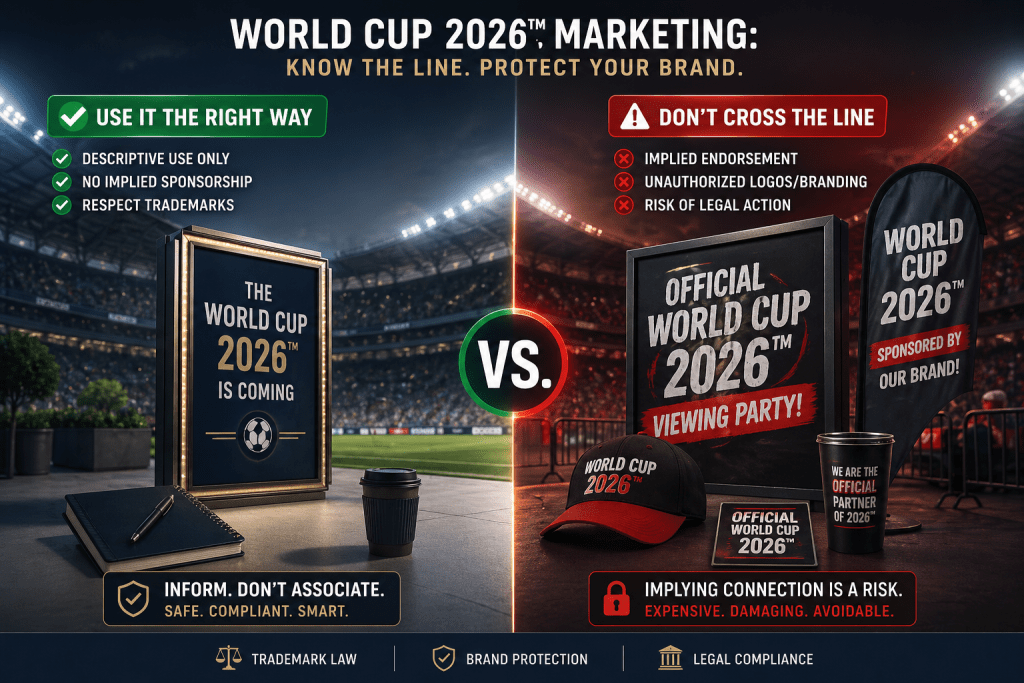
Understanding World Cup 2026 trademarks in the USA is essential for businesses planning to market around the tournament.
Most businesses believe that avoiding official logos or names is enough to stay safe when marketing around major events like the FIFA World Cup 2026™.
It isn’t.
In trademark law, the real risk is not just what you use—it’s what your audience believes when they see it. If your campaign creates the impression of affiliation, sponsorship, or endorsement, you may already be crossing a legal line.
With the FIFA World Cup 2026™ set to span 16 U.S. cities and generate massive commercial activity, the temptation for businesses to “tap into the moment” is stronger than ever. But so is the enforcement.
This article is about how trademark law actually works in practice—and why many businesses get it wrong.
1. Trademark Under U.S. Law
Let’s break down the legal foundation first. A trademark isn’t merely decoration or branding flair—it’s a commercial signal protected by law. Under the Lanham Act (15 U.S.C. § 1051 et seq.), the federal framework governing U.S. trademarks, a mark can be any word, phrase, symbol, design, or combination that identifies the source of goods or services and distinguishes them from others in interstate commerce.
a. The Core Elements of Protection
Trademarks come in recognizable forms, all equally enforceable:
- Words and Phrases: Like “FIFA World Cup 2026™” or “World Cup 26™”—exact terms FIFA registers to block competitors.
- Symbols and Logos: The Official Emblem, Trophy silhouette (unveiled 2023 in LA), and 16 Host City variants.
- Slogans: “We Rise Together” or future taglines that evoke official affiliation.
- Design Elements: Even the custom FWC 2026 typeface receives copyright and design protection.
Important: These aren’t protected in isolation. The Lanham Act safeguards the commercial goodwill they represent—precisely what FIFA defends to secure sponsor exclusivity.
b. The Pivotal Doctrine: Likelihood of Confusion
Infringement doesn’t demand verbatim copying. It hinges on the likelihood of confusion—whether a reasonable consumer might assume your “WC26 Soccer Party” promotion implies FIFA sponsorship.
Courts weigh multi-factor tests:
- Mark strength (FIFA’s are “famous,” strongest protection)
- Similarity in sight/sound/meaning
- Proximity of goods/services (sports events vs. your bar promotion)
- Actual confusion evidence
- Defendant’s good faith
FIFA Guidelines example: A restaurant’s “FIFA Finales Week Specials” doesn’t copy the Emblem but risks implying endorsement—precisely the “undue commercial association” FIFA prohibits.
Related: College Sports Trademark Battles: From Rivalries to Courtrooms & Brand Control
2. FIFA World Cup 2026: What Is Actually Protected?
FIFA’s protection strategy goes far beyond logos. For the 2026 World Cup, protected assets include:
- Official Emblem (Trophy integrated into “2026”)
- Wordmarks (“FIFA World Cup 2026™”, “World Cup 26™”)
- Official slogans (e.g., “We Rise Together”)
- Host City branding systems
- Official typography and design
- Mascots and visual campaigns
- Posters and creative assets
- Broadcast and digital branding
FIFA Intellectual Property Guidelines emphasize a critical point: Protection extends not only to identical uses—but also to confusingly similar variations and implied associations.
This is not just brand protection. It’s control over the commercial narrative of the event.
Related: The 2026 FIFA World Cup: What the Numbers Really Say
Related: FIFA World Cup 26™ Official Brand unveiled
3. Why FIFA Enforces Its Trademarks So Aggressively

The World Cup operates on a sponsorship-driven model, where global brands pay significant amounts for the right to be officially associated with the tournament. That association is not symbolic—it’s the core of the value they are purchasing. Those rights typically include:
- Exclusive branding opportunities
- Global visibility across media platforms
- Category exclusivity within their industry
If non-sponsors could freely reference or align themselves with the event, that exclusivity would quickly erode. And with it, the value of sponsorship. Trademark enforcement it’s about preserving the commercial integrity of the tournament.
a. Ambush Marketing and the Real Legal Risk
Ambush marketing occurs when a brand attempts to benefit from the visibility of a major event—like the World Cup—without being an official sponsor. Instead of using trademarks directly, these campaigns rely on indirect association.
Most ambush marketing does not look like infringement at first glance. In fact, it often appears creative, timely, and perfectly aligned with the moment.
But legally, the issue is not creativity—it’s perception. If a campaign leads consumers to believe there is a connection to the event, it may trigger liability under trademark law.
Source: Inside FIFA: Brand Protection
b. FIFA’s Commercial Affiliates: The Only Legal Path to Association
FIFA does not leave commercial associations open to interpretation. Instead, it channels all legitimate use of its intellectual property through a structured sponsorship system.
This system includes several tiers—from global partners with broad rights across all competitions to regional and local supporters with more limited permissions tied to the World Cup or specific host cities.
Source: FIFA Intellectual Property Guidelines
Despite these differences, the principle is consistent: Only official affiliates are permitted to use FIFA’s intellectual property for commercial purposes.
c. Clean Zones: Where Enforcement Becomes Physical
One of the most tangible—and often overlooked—enforcement tools used during major events like the World Cup is the concept of “clean zones.”
Rather than physical barriers, Clean Zones are defined as designated areas on a map where specific commercial restrictions apply. During matchdays—and in the days leading up to them—unauthorized businesses are limited in how they can operate within these zones.
Source: Inside FIFA: Brand Protection
In practice, Clean Zones ensure that only official sponsors can maintain a visible commercial presence in and around event venues.
At the same time, enforcement is not limited to physical spaces. For the 2026 World Cup, FIFA is expected to operate across multiple fronts—combining digital monitoring of social media and advertising campaigns, active trademark surveillance at the USPTO, and coordinated anti-counterfeiting efforts through customs authorities. The approach remains consistent: educate where possible, and enforce decisively where necessary.
d. Real Cases, Real Lessons
FIFA doesn’t just publish guidelines—it litigates aggressively.
- Bavaria Beer (World Cup 2010, South Africa): During Netherlands vs. Denmark, 36 women entered the stadium wearing skin-tight orange mini-dresses branded “Dutchy” by Bavaria Beer—a non-sponsor (Budweiser was official). Orange = Dutch national color. No FIFA logos, just visual association.
FIFA’s Response: Immediate halftime removal of all participants. Criminal charges against Bavaria executives (some served jail time). Civil lawsuit alleging trademark infringement and ambush marketing. Bavaria gained viral PR but paid millions in penalties.
Legal Principle: No literal copying needed. Proximity to event + national colors = consumer confusion about sponsorship. Courts ruled the “association” itself violated FIFA’s IP rights. - Brazil 2014: “BRASIL 2014™” Unauthorized Uses: Retail giant Cencosud printed “BRASIL 2014™” on tickets and promotions. Hotels offered “World Cup Packages.” Local businesses used “Brasil 2014” everywhere without licenses.
FIFA’s Response: Mass cease-and-desist letters followed by federal injunctions. Courts halted printing/sales immediately. Confiscated merchandise. Damages awarded. FIFA’s message: “Host country + year” = protected format.
Legal Principle: Consumers reasonably assumed official affiliation. No “fair use” defense survived.
Related: March Madness: From Exposure to Opportunity
4. Conclusion
The FIFA World Cup 2026™ will create massive commercial opportunity—but also a legal landscape where small marketing decisions can carry real risk.
In this context, trademark law operates through perception. Campaigns that feel creative or timely can still raise issues if they suggest a connection that does not exist. FIFA’s enforcement model—through sponsorship structures, clean zones, and coordinated monitoring—reflects how seriously that risk is managed.
For businesses, the challenge is not just avoiding mistakes, but approaching the moment strategically. The brands that navigate this successfully will be the ones that understand the boundaries and still build campaigns that are relevant, original, and clearly their own.
5. FAQ
- Can I use “World Cup 2026” in my advertising?
Not safely in a commercial context. Even without “FIFA,” it may still imply association and create legal risk. - Is it legal to post about matches on social media?
Yes, if it’s non-commercial or informational. Problems arise when posts promote a business. - Can I host a viewing event?
Yes—but you cannot present it as “official” or affiliated with FIFA without authorization. - What is the most common mistake businesses make?
Believing that avoiding logos is enough. Most issues arise from implied association, not direct copying. - How can I safely market during the World Cup?
Focus on original campaigns, general football themes, and avoid anything suggesting affiliation.
About the Author
Alexander R. Karana is an Intellectual Property and International attorney at Cummings, McClorey, Davis & Acho, PLC (CMDA), admitted to practice in Michigan, Illinois, and before the United States Patent and Trademark Office. He focuses on patent and trademark prosecution, IP strategy, and entertainment law. Alexander has been recognized by Best Lawyers: Ones to Watch in America and Super Lawyers: Rising Stars for his work in IP and Sports & Entertainment law.
Email Alexander
His practice includes intellectual property law with a focus on patent and trademark prosecution, IP litigation, and brand protection strategies, as well as business transactions and contract drafting and negotiation. He regularly advises clients on patent applications, trademark clearance and registration, licensing agreements, infringement and enforcement matters, and technology-related legal issues. His practice also extends to sports and entertainment law, including name, image, and likeness (NIL) matters, where he represents athletes, entertainers, and content creators in business negotiations, endorsement and sponsorship agreements, and related disputes and litigation.
Alexander helps inventors, entrepreneurs, and online brands protect and monetize innovation through patent and trademark prosecution, strategic IP enforcement, and commercial transactions.
Contact: AKarana@cmda-law.com | 17436 College Parkway, Livonia, MI 48152
Legal Disclaimer: This article is for informational purposes only and does not constitute legal advice. Reading it or contacting the author does not create an attorney–client relationship. Each case is unique; consult a qualified attorney for your specific situation.