

Behind every transfer, contract extension, or sponsorship deal in football, there is usually a football agent—but their role is often misunderstood. Agents are not just negotiators closing deals at the final stage; they influence careers, financial outcomes, and the commercial value of players, clubs, and even coaches.
This article breaks it down in a practical way, through the lens of law and business. It explains what football agents do, how FIFA’s licensing system and fee-cap rules try to regulate the profession, why the Dortmund case created uncertainty, and how agent activity connects with image rights, sponsorships, and brand value.
This post is about understanding the modern football agent not only as a representative or intermediary, but as a key actor in the business structure of football.
Related: Football Transfers Explained: A Practical Guide
Related: The 2026 FIFA World Cup: What the Numbers Really Say
1. FOOTBALL AGENT
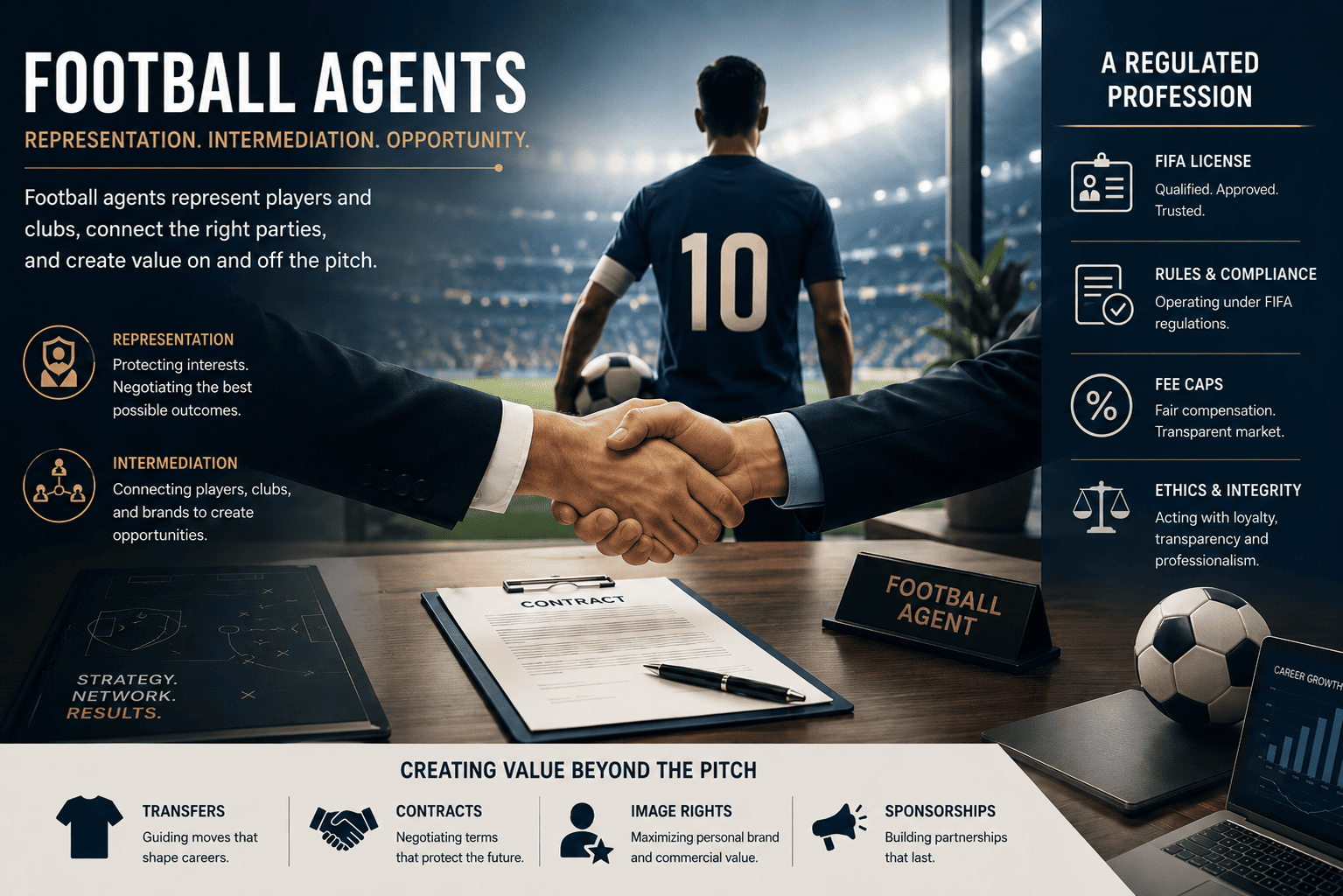
In practice, football agents operate through two interconnected functions: representing their clients and intermediating between different parties. These roles are not separate in reality—they constantly overlap, and the way agents balance them often determines whether deals are efficient, fair, or problematic.
a. Representation
When an agent represents a player (or, in some cases, a club), they act as the client’s advisor and negotiator. Their work typically includes negotiating employment contracts, structuring endorsement opportunities, and guiding long-term career decisions.
But representation is not just about negotiating numbers. It is built on loyalty and advocacy. The agent is expected to act in the client’s best interests, even when negotiating with powerful clubs or commercial partners. In theory, this creates a relationship of trust. In practice, it is also where tensions can arise, particularly when financial incentives or external pressures begin to shape decision-making.
This dynamic becomes especially relevant in the context of name, image, and likeness. Decisions taken during contract negotiations—such as how image rights are structured or which sponsorships are prioritized—can directly affect how a player’s personal brand is used and monetized in the market. At the same time, it is important to recognize the limits of the agent’s role. While agents often participate in these discussions and can provide valuable guidance, they are not necessarily specialists in intellectual property or brand protection. For that reason, players and clubs frequently rely on legal advisors who focus specifically on these areas to complement the agent’s work.
b. Intermediation
Alongside representation, agents perform a second function that is less visible but equally important: intermediation. Here, the agent operates within a network, connecting parties and creating the conditions for deals to happen.
This can involve introducing a player to a club, facilitating discussions between clubs and sponsors, or aligning multiple stakeholders in more complex transactions. Unlike representation, which is centered on loyalty to a client, intermediation is more about positioning within the market. Access—to clubs, decision-makers, and commercial partners—often determines which opportunities become available in the first place.
As a result, agents are not only negotiating deals; they are shaping the market in which those deals occur. Their networks, timing, and strategic positioning can influence outcomes just as much as the terms written in a contract.
Together, these two functions define the modern football agent. They protect interests while creating opportunities—and the balance between those roles is what ultimately shapes transparency and fairness in the industry.
2. The FIFA License Regulations

a. From Deregulation to Re-Regulation
For years, the agent profession developed in a relatively fragmented and loosely regulated environment. FIFA’s Football Agent Regulations represent a clear attempt to change that by introducing a more formal, standardized framework.
This shift did not happen overnight. After several years of debate, regulatory gaps, and earlier attempts to control intermediaries that proved difficult to enforce—particularly following the deregulation of the system in 2015—FIFA reintroduced a licensing system in 2023 as part of a broader effort to regain oversight of the market.
b. Licensing as a Gatekeeping Mechanism
At the center of this system is licensing. To act as a football agent under FIFA rules, an individual must meet eligibility requirements, pass an exam, and comply with ongoing obligations (Section II of the FIFA Football Agent Regulations).
This transforms access to the profession. It is no longer based purely on relationships or market presence, but on formal qualification and continued compliance. More importantly, licensing acts as a gatekeeping mechanism: participation in international transfers is now tied to regulatory approval, not just commercial opportunity.
c. Fee Caps and Market Incentives
One of the most controversial aspects of FIFA’s regulatory framework is the introduction of service fee caps, set out in Article 15 of the Football Agent Regulations.
Under this provision, the amount an agent can earn is not freely negotiated, but limited based on the type of representation and the value of the transaction. When representing a player or engaging club, fees are generally capped at 5% of remuneration (up to USD 200,000) and 3% above that threshold, while in cases of dual representation the cap increases within defined limits. In transfer scenarios, where the agent represents the releasing club, the fee is capped at 10% of the transfer compensation
Beyond the percentages, the objective is structural. FIFA is attempting to control incentives in the market by limiting excessive commissions, reducing conflicts of interest, and increasing transparency. Unsurprisingly, these limits—particularly the fee caps—have become a central point of legal challenge, as illustrated by the Dortmund case.
d. The Dortmund Case: When Local Law defined Global Rules
FIFA’s attempt to standardize the agent market quickly faced resistance. In 2023, a group of agents successfully challenged key provisions of the Football Agent Regulations before the Regional Court of Dortmund, particularly those relating to fee caps, payment structures, and limits on representation.
The court granted a preliminary injunction preventing FIFA and the German federation from applying several of these rules, finding that they could restrict competition by limiting how agents negotiate fees and operate in the market . Although the decision was issued by a German court, its impact extended far beyond Germany. In response, FIFA was effectively forced to suspend the enforcement of certain provisions of its regulations on a broader, international level.
This is what makes the case particularly significant. A regulatory framework designed to operate globally was disrupted by a national decision, creating immediate uncertainty for agents, clubs, and players across jurisdictions.
In that sense, the Dortmund case is not just about agent fees or regulatory detail. It highlights a structural tension: FIFA may regulate the system, but it does not operate above the law. National courts—and, ultimately, competition law—remain a decisive check on how far that regulation can go.
Case: Regional Court (LG) of Dortmund (judgement of 24 May 2023, 8 O 1/23 (Kart))
3. Trademarks, and Brand Protection

At first glance, the work of football agents does not appear closely connected to intellectual property in the traditional sense. In practice, however, there is a clear and increasingly important connection when it comes to name, image, and likeness.
Modern players are not only athletes; they are public figures whose identity—name, image, and reputation—generates significant commercial value. When an agent negotiates a contract it often extends to how image rights are allocated between player and club, whether the player retains the ability to negotiate individual sponsorship agreements outside the club’s commercial framework, or, conversely, how clubs structure their own partnerships with brands that may involve the player’s image.
These scenarios are part of the commercial reality of modern football. A player may want to enter into personal endorsement deals, while the club may already have existing sponsorship agreements that impose limitations or create conflicts. How these interests are balanced at the negotiation stage will directly determine how the player’s identity can be used, monetized, and developed over time.
At the same time, these decisions carry legal implications that go beyond the negotiation itself. While agents bring market knowledge, strategic positioning, and access to opportunities, they are not necessarily specialists in the legal structuring of image rights or in managing the risks associated with them.
In modern football, working with specialized lawyers is no longer optional, but a necessary part of reviewing and negotiating these agreements. Their involvement ensures that commercial opportunities are not only attractive in the short term, but also properly structured, protected, and capable of delivering long-term value.
Related: World Cup 2026 Trademark Rules: What U.S. Businesses Need to Know
Related: AI & Celebrity NIL: An Intellectual Fight to Protect Real Identities
4. Conclusion
Football agents are central figures in a system where sporting, commercial, and regulatory interests increasingly intersect. They influence not only how deals are structured, but how value is created and distributed across the football industry.
FIFA’s regulatory framework reflects an effort to bring order to this space, introducing licensing requirements, fee caps, and rules designed to increase transparency and limit conflicts of interest. However, as the Dortmund case illustrates, these ambitions remain subject to legal limits and can be reshaped by national courts, creating a system that is both more structured and inherently uncertain.
At the same time, the impact of agents extends beyond transfers and contracts. By shaping decisions around image rights, sponsorships, and market positioning, they play a key role in the development of players as commercial assets. In this context, aligning commercial strategy with specialized legal advice becomes essential to ensure that value is not only created, but properly structured and protected over time.
Understanding football agents, therefore, is not only about understanding how transfers work—it is about understanding how modern football operates at the intersection of sport, business, and law.
5. FAQ
Q: What is the difference between a football agent and a FIFA‑licensed agent?
A: A football agent is anyone who represents or intermediates for players or clubs. A FIFA‑licensed agent is one who meets FIFA’s exam and registration requirements, fundamental for international negotiations.
Q: Does the Dortmund case affect agents outside Europe?
A: Yes and no. The case started in Germany, but it forced FIFA to suspend parts of its global agent‑fee rules, so agents and clubs around the world had to operate in a more uncertain environment for a time.
About the Author
Alexander R. Karana is an intellectual property and international attorney at Cummings, McClorey, Davis & Acho, PLC (CMDA), admitted to practice in Michigan, Illinois, and before the United States Patent and Trademark Office. He focuses on patent and trademark prosecution, IP strategy, and entertainment law. Alexander has been recognized by Best Lawyers: Ones to Watch in America and Super Lawyers: Rising Stars for his work in IP and Sports & Entertainment Law.
Email Alexander
His practice includes intellectual property law with a focus on patent and trademark prosecution, IP litigation, and brand protection strategies, as well as business transactions and contract drafting and negotiation. He regularly advises clients on patent applications, trademark clearance and registration, licensing agreements, infringement and enforcement matters, and technology-related legal issues. His practice also extends to sports and entertainment law, including name, image, and likeness (NIL) matters, where he represents athletes, entertainers, and content creators in business negotiations, endorsement and sponsorship agreements, and related disputes and litigation.
Alexander helps inventors, entrepreneurs, and online brands protect and monetize innovation through patent and trademark prosecution, strategic IP enforcement, and commercial transactions.
Contact: akarana@cmda-law.com | 17436 College Parkway, Livonia, MI 48152
Legal Disclaimer: This article is for informational purposes only and does not constitute legal advice. Reading it or contacting the author does not create an attorney–client relationship. Each case is unique; consult a qualified attorney for your specific situation.