

FIFA World Cup 2026 technology is redefining how football is played, officiated and experienced. From connected balls and artificial intelligence to player tracking systems and smart stadium infrastructure, the tournament showcases some of the most advanced innovations ever deployed in professional sport.
Over the last decade, football’s most prestigious tournament has evolved into a showcase for advanced technologies that would have seemed futuristic only a few years ago. Intelligent footballs embedded with sensors, artificial intelligence-powered officiating systems, real-time player tracking, predictive analytics, and smart stadium infrastructure have become integral parts of the modern World Cup experience.
Behind these innovations lies an often-overlooked reality: many of the technologies transforming football are protected by patents, trade secrets, software licenses, and complex intellectual property portfolios. As a result, the World Cup is also a demonstration of how innovation, intellectual property, and business strategy increasingly shape the future of sports.
Related: “World Cup 2026 Trademark Rules: What U.S. Businesses Need to Know”
The table below highlights some of the key technology categories discussed in this article and examples of organizations associated with innovations in these areas.
Technology | Example Patent Owner |
Connected Ball | Adidas, Kinexon |
Semi-Automated Offside | Hawk-Eye |
Player Tracking | Catapult, STATSports |
Football AI | Lenovo, FIFA partners |
Stadium Connectivity | Cisco, Ruckus, Aruba |
1. The Connected Ball: When the Football Starts Talking

Legal and Business Considerations
Several important legal questions emerge:- Who owns the data generated by the ball?
- What rights do players, clubs, and federations have regarding its use?
- Can that data be licensed to broadcasters, betting operators, or analytics providers?
- How should confidentiality obligations be structured between technology suppliers and sports organizations?
2. VAR and Semi-Automated Offside Technology

Advanced Semi-Automated Offside Technology
The new system relies on a network of optical tracking cameras installed throughout the stadium, generating millions of data points during each match. To further improve accuracy, every player participating in the tournament is digitally scanned before the competition, creating a 3D avatar that can be integrated into the officiating system. This technology not only supports faster decision-making but also improves transparency for fans by enabling highly realistic 3D visualizations of offside incidents during broadcasts (Inside FIFA).Beyond Offside Decisions
The tracking infrastructure supporting SAOT has applications beyond traditional officiating. By recreating matches in three dimensions, officials can review complex scenarios such as whether an offside player obstructed a goalkeeper’s view or whether the ball crossed the touchline during the build-up to a goal. The same data can also be used by broadcasters to generate immersive visualizations and by teams to conduct detailed performance analysis (Inside FIFA).Legal and Commercial Considerations
As football increasingly relies on AI-driven decision support systems, new legal and governance questions emerge:- Who bears responsibility if an automated recommendation is incorrect?
- How transparent should governing bodies be regarding the operation of officiating algorithms?
- Who owns the tracking data and digital player models generated during competition?
- How should technology providers allocate liability and performance obligations in their agreements with sports organizations?
3. Performance Tracking Systems and Wearable Technologies
From Innovation to Standardization
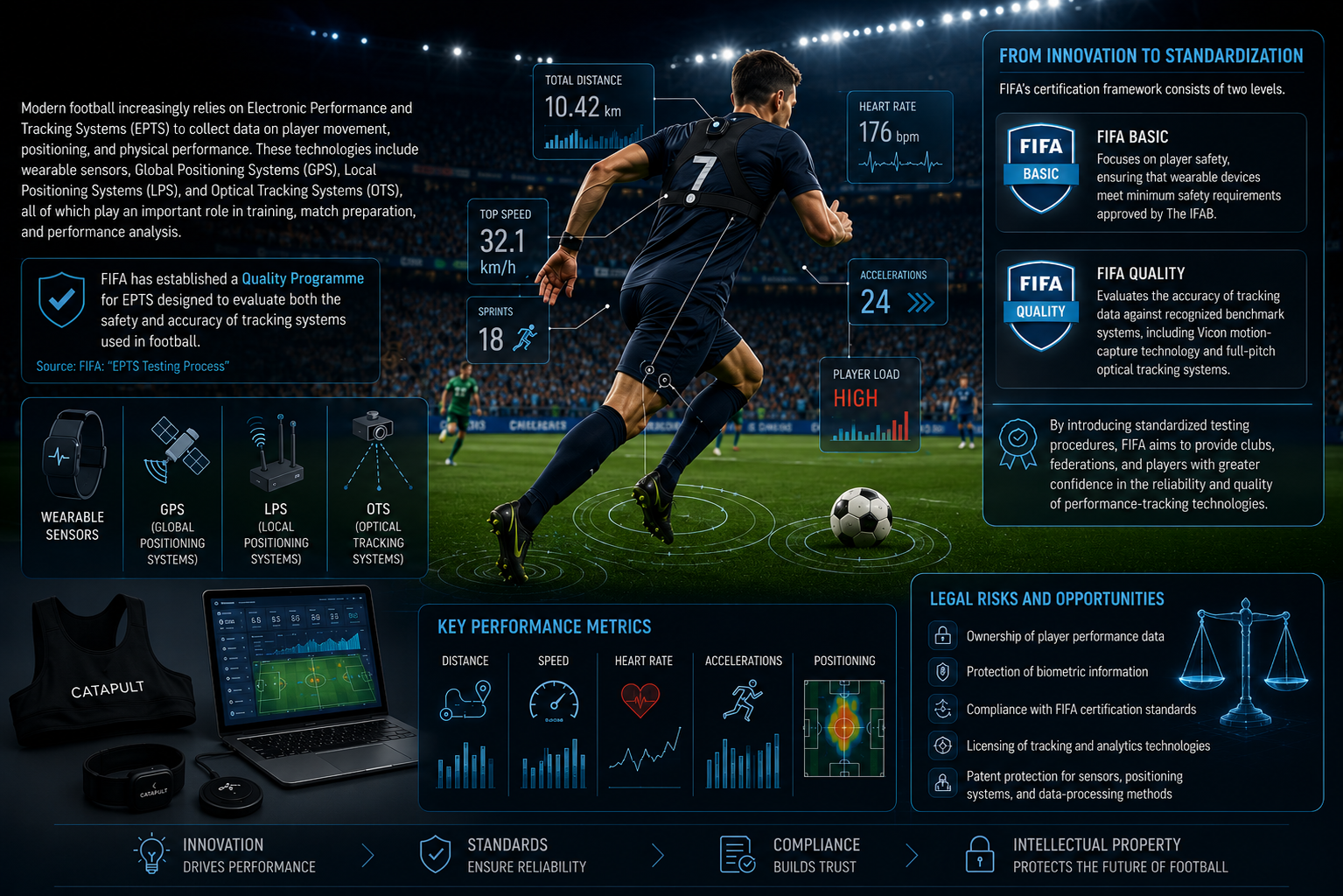
FIFA’s certification framework consists of two levels. The FIFA Basic standard focuses on player safety, ensuring that wearable devices meet minimum safety requirements approved by The IFAB. The FIFA Quality standard goes a step further by evaluating the accuracy of tracking data against recognized benchmark systems, including Vicon motion-capture technology and full-pitch optical tracking systems. By introducing standardized testing procedures, FIFA aims to provide clubs, federations, and players with greater confidence in the reliability and quality of performance-tracking technologies.Legal Risks and Opportunities
As tracking technologies become more sophisticated, several legal and commercial issues arise:- Ownership of player performance data
- Protection of biometric information
- Compliance with FIFA certification standards
- Licensing of tracking and analytics technologies
- Patent protection for sensors, positioning systems, and data-processing methods
4. Artificial Intelligence and Football Analytics

Democratizing Match Analysis
Traditionally, access to sophisticated performance analysis has depended on a team’s financial and technical resources. Football AI Pro seeks to level the playing field by providing every participating nation with the same analytical capabilities before and after matches. By transforming complex datasets into accessible insights, AI has the potential to make elite-level analysis available to teams regardless of size or budget.AI Beyond Performance Analytics
FIFA’s Football AI ecosystem extends beyond team analysis. AI-enabled 3D player avatars support officiating technologies by improving player identification and tracking, while AI-powered video stabilization enhances referee body camera footage, creating a more immersive viewing experience for fans. Together, these innovations demonstrate how artificial intelligence is becoming embedded across multiple aspects of the modern game—from competition management and officiating to broadcasting and fan engagement.Legal Risks and Opportunities
As AI becomes increasingly integrated into football, several intellectual property and business considerations emerge:- Ownership of AI-generated insights and outputs
- Protection of proprietary datasets and training models
- Licensing of AI-powered platforms and analytics tools
- Use of digital player representations and 3D avatars
- Competitive advantages derived from exclusive access to sports data
5. Smart Stadiums and the Digital Fan Experience

The Connectivity Challenge
Providing wireless connectivity in a stadium is uniquely complex. Tens of thousands of spectators may attempt to connect simultaneously, particularly during key moments of a match, placing significant pressure on network capacity. At the same time, stadium networks must support critical functions such as ticketing, security, broadcasting, and venue operations, all without compromising performance or reliability (IotInsider).Next-Generation Stadium Infrastructure
To meet these demands, modern venues are deploying high-density Wi-Fi networks, intelligent access point configurations, and AI-driven network optimization tools. Emerging technologies such as Wi-Fi 7 are expected to further enhance connectivity by delivering faster speeds, lower latency, and improved performance in high-density environments—capabilities that may play an increasingly important role during the FIFA World Cup 2026 (IotInsider).Legal Risks and Opportunities
As stadiums become more connected, organizations must address a range of legal and compliance issues, including:- Cybersecurity and network resilience
- Data privacy and protection requirements
- Ownership and commercial use of operational data
- Technology licensing and vendor management
- Intellectual property rights associated with networking and AI systems
6. Why Patents Matter in Modern Football
The technologies transforming the FIFA World Cup 2026—from connected balls and AI-assisted officiating to player tracking systems and smart stadium infrastructure—are more than just innovations. They are valuable intellectual property assets. Developing these technologies requires significant investment in research, engineering, software development, and data infrastructure. Patents help protect those investments by granting inventors exclusive rights to commercialize their innovations, license them to others, and prevent unauthorized use. Related: “Intellectual Property Guide for Startups in 2026” In the sports technology industry, patents can provide several strategic advantages:- Protecting technological innovation from competitors
- Creating licensing and revenue opportunities
- Supporting partnerships with leagues, clubs, and governing bodies
- Increasing company valuation and investor interest
- Establishing competitive barriers to entry
7. Conclusion
The next breakthrough in football may not be scored on the pitch. It may be filed first at a patent office. The FIFA World Cup has evolved into one of the world’s most visible showcases for technological innovation. Smart balls, AI-assisted officiating, advanced analytics platforms, and intelligent stadium infrastructure are no longer experimental concepts—they are becoming foundational elements of modern sport. For clubs, startups, investors, and sports governing bodies, the real competitive advantage increasingly lies not only in adopting new technologies but also in understanding the intellectual property rights that protect them. Those who recognize this shift early will be better positioned to capitalize on the next generation of sports innovation. Those who ignore it may discover that the future of football is being shaped as much by patents and data rights as by goals and trophies.ABOUT THE AUTHOR
Alexander R. Karana is an intellectual property and international attorney at Cummings, McClorey, Davis & Acho, PLC (CMDA), admitted to practice in Michigan, Illinois, and before the United States Patent and Trademark Office. He focuses on patent and trademark prosecution, IP strategy, and entertainment law. Alexander has been recognized by Best Lawyers: Ones to Watch in America and Super Lawyers: Rising Stars for his work in IP and sports & entertainment law.
EMAIL ALEXANDER
His practice includes intellectual property law with a focus on patent and trademark prosecution, IP litigation, and brand protection strategies, as well as business transactions and contract drafting and negotiation. He regularly advises clients on patent applications, trademark clearance and registration, licensing agreements, infringement and enforcement matters, and technology-related legal issues. His practice also extends to sports and entertainment law, including name, image, and likeness (NIL) matters, where he represents athletes, entertainers, and content creators in business negotiations, endorsement and sponsorship agreements, and related disputes and litigation.
Alexander helps inventors, entrepreneurs, and online brands protect and monetize innovation through patent and trademark prosecution, strategic IP enforcement, and commercial transactions.
Contact: akarana@cmda-law.com | 17436 College Parkway, Livonia, MI 48152
Legal Disclaimer: This article is for informational purposes only and does not constitute legal advice. Reading it or contacting the author does not create an attorney-client relationship. Each case is unique; consult a qualified attorney for your specific situation.