

This intellectual property guide for startups explains how founders, entrepreneurs, and growing businesses can protect trademarks, patents, copyrights, trade secrets, AI-generated assets, and competitive advantages in 2026.
How to Protect Your Ideas, Brand, Content, Inventions, and Competitive Advantage in 2026 and Beyond
This guide is for founders, entrepreneurs, creators, inventors, family businesses, startups, and growing companies that want to build something valuable and protect it the right way.
The modern business world moves fast. A product can go viral overnight. A brand can become known in a week. An AI tool can turn an idea into a mockup, a logo, a website, a pitch deck, or software prototype in minutes.
That speed creates opportunity.
It also creates risk.
Intellectual property, often called IP, is how businesses protect the things that make them different: ideas, inventions, names, logos, software, content, confidential information, designs, customer goodwill, and know-how.
The smartest entrepreneurs do not wait until there is a lawsuit, copycat, investor meeting, licensing deal, or acquisition. They build IP strategy into the business from the beginning.
This guide explains the four major areas of IP:
- Trade Secrets
- Trademarks
- Patents
- Copyrights
It also explains how IP works with business formation, contracts, liability protection, artificial intelligence, and go-to-market strategy.
1. Start With Trade Secrets
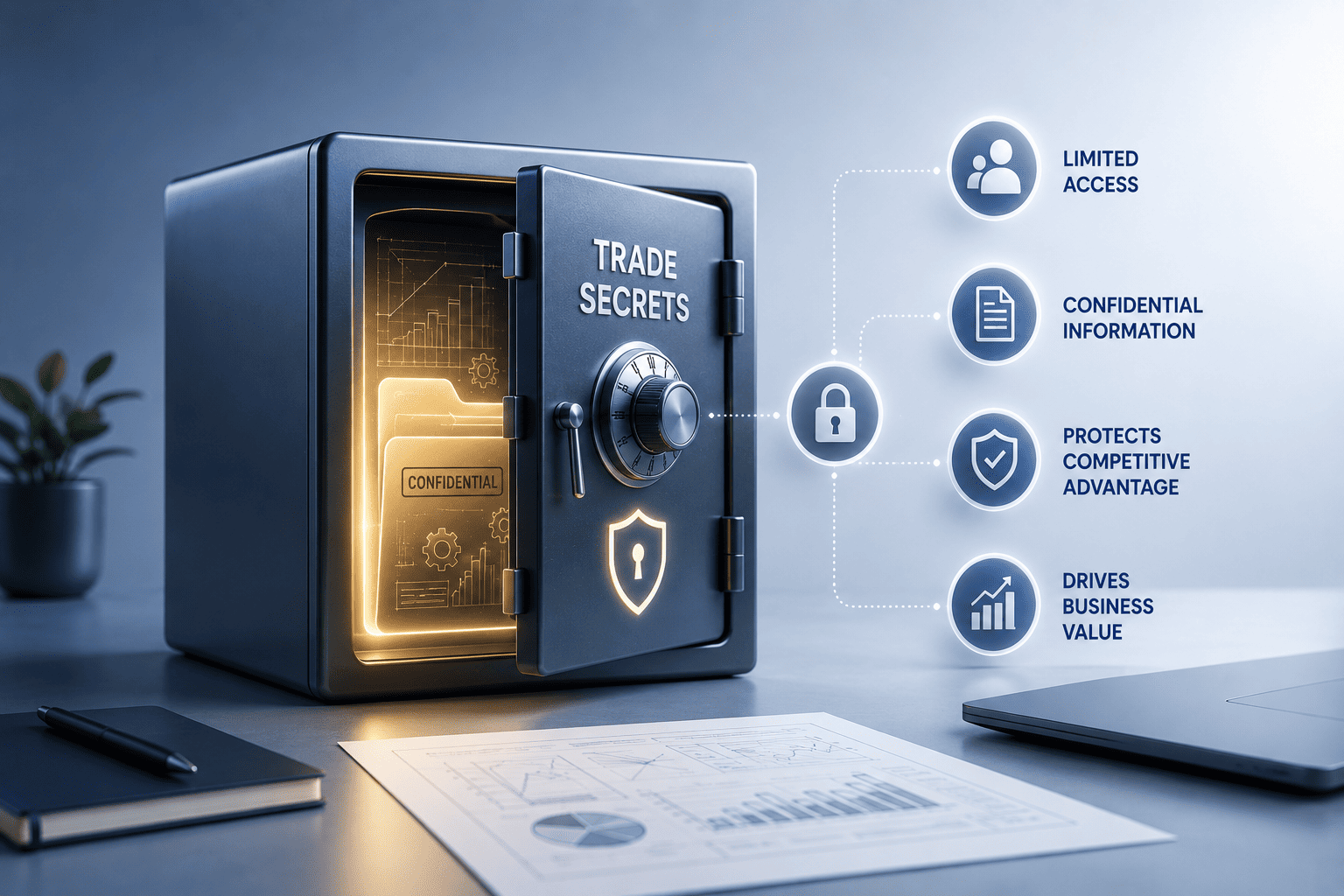
Because Everything Is a Trade Secret Before It Becomes Public.
Before your business name is announced, before your product is launched, before your invention is filed as a patent application, and before your strategy is shared with the world, it may be confidential business information.
That is why founders should think about trade secrets first.
A trade secret can include information that gives a business economic value because it is not generally known and because the business takes reasonable steps to keep it secret. Under the federal Defend Trade Secrets Act, an owner of a trade secret may bring a civil action for misappropriation if the trade secret relates to a product or service used in, or intended for use in, interstate or foreign commerce (USPTO: Trade Secret Policy). 
A. Common Examples of Trade Secrets
Trade secrets may include:
- Product formulas
- Manufacturing methods
- Supplier lists
- Customer lists
- Pricing strategy
- Business plans
- Source code
- AI prompts and workflows
- Internal datasets
- Training data
- Product roadmaps
- Sales scripts
- Confidential pitch decks
- Prototype details
- Unfiled invention disclosures
- Recipes and processes
- Vendor terms
- Market research
- Algorithms and model architecture
Trade secrets are not only for giant companies. A sandwich shop, fitness brand, software startup, medical device company, influencer agency, automotive supplier, agricultural technology company, or consumer product startup may all have trade secrets.
The Practical Rule: If it gives your business an advantage, and competitors would benefit from knowing it, treat it like a trade secret until you decide otherwise.
B. How to Protect Trade Secrets
Trade secret protection depends heavily on conduct. You must act like the information is secret. Practical steps include:
- Use NDAs before sharing confidential information.
- Limit access to people who need to know.
- Use password protection and access controls.
- Label sensitive documents “Confidential.”
- Use contractor and employee agreements.
- Keep invention notebooks or development records.
- Avoid public disclosure before filing patent applications.
- Do not upload confidential information into public AI tools.
- Have written policies for data, AI, and confidentiality.
- Remove access when employees, contractors, or vendors leave.
C. AI Warning for 2026
In 2026, trade secret protection must include AI hygiene.
Founders should not paste confidential source code, invention details, customer lists, nonpublic financials, prototype images, confidential pitch decks, or legal documents into AI tools without understanding how the tool uses, stores, trains on, or shares that data.
AI can be useful. But careless AI use can destroy secrecy.
A practical AI policy should answer:
- What AI tools can employees use?
- What information may never be entered into AI tools?
- Are paid enterprise tools required for confidential work?
- Who reviews AI-generated content before publication?
- How are prompts, outputs, and human edits documented?
- Are AI-generated images, code, or written materials cleared before commercial use?
National Institute Of Standard & Technology (NIST) AI Risk Management Framework is a voluntary framework intended to help organizations incorporate trustworthiness considerations into the design, development, use, and evaluation of AI systems.  For businesses using generative AI, NIST has also published a Generative AI Profile identifying unique risks and proposed actions for managing them. 
Founder Advice: “Trade secret protection is not glamorous. It is not a logo, press release, or launch party.”
But it may be the most important first step.
Before you show the world what you built, decide what should stay confidential.
2. Trademarks
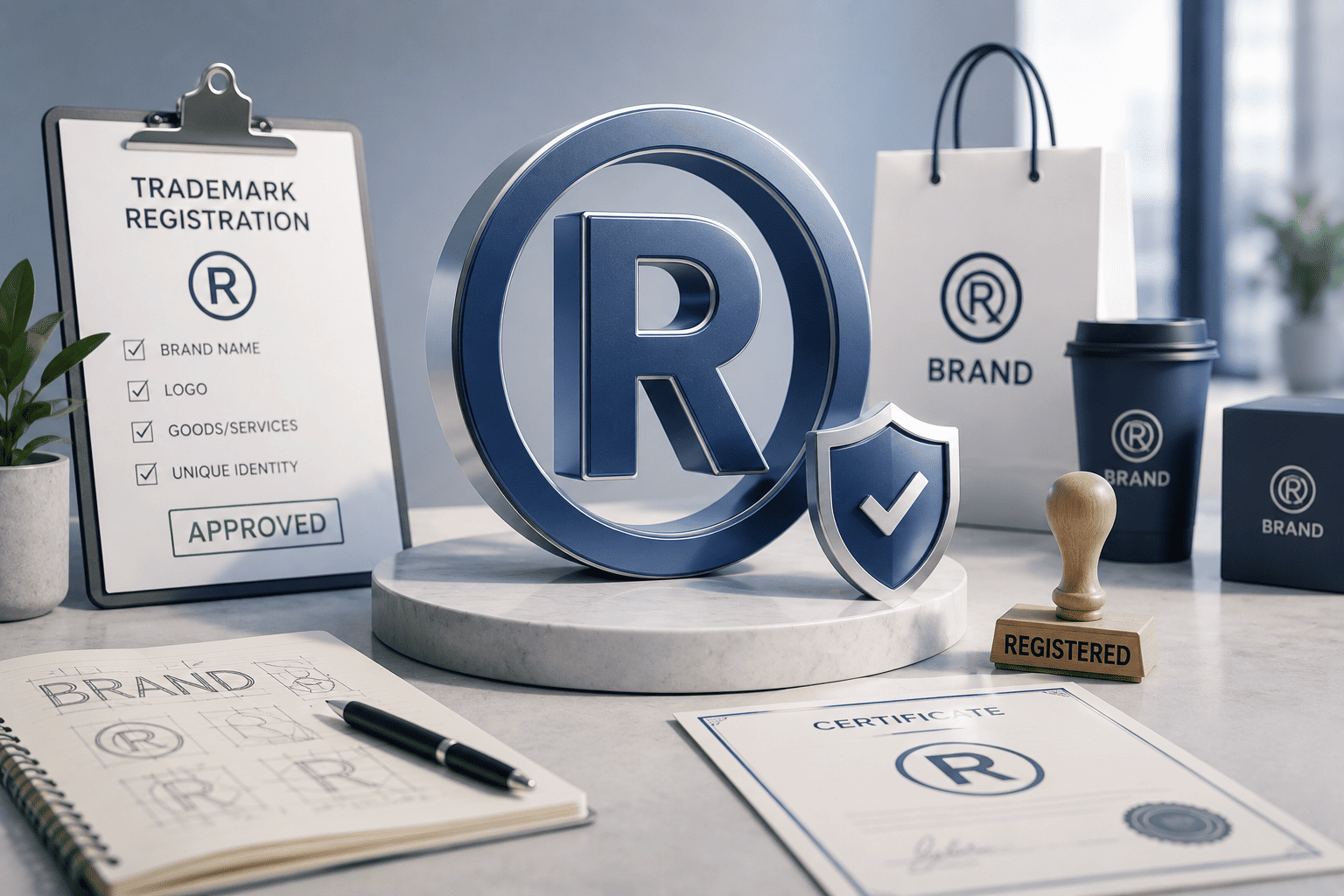
A. Protect the Name, Logo, Slogan, and Brand Customers Recognize
A trademark protects brand identity.
It can protect names, logos, slogans, product names, service names, and other identifiers that help customers know where goods or services come from.
The Lanham Act provides a national trademark registration system and protects owners of federally registered marks against uses of similar marks that are likely to cause consumer confusion. 
Related: FIFA, Trademarks, and the World Cup Brand: What Businesses Need to Know
B. Examples of Trademarks
Trademarks may include:
- Business names
- Product names
- App names
- Restaurant names
- Clothing brand names
- Software platform names
- Logos
- Taglines
- Podcast names
- YouTube channel names
- Event names
- Franchise names
For example:
- A startup’s company name may be a trademark.
- A fitness product’s name may be a trademark.
- A restaurant logo may be a trademark.
- A college NIL training platform name may be a trademark.
- A medical device brand name may be a trademark.
- An AI software tool name may be a trademark.
C. A Domain Name Is Not Enough
Buying a domain name does not mean you own the trademark.
A domain name gives you control over a web address. It does not automatically give you the right to use that name in commerce.
The same is true for social media handles.
Owning the Instagram, TikTok, LinkedIn, X, or YouTube handle is useful. But it does not automatically mean you have trademark priority.
D. How to Pick a Strong Business Name
When choosing a name, think like both a marketer and a lawyer.
A strong name should be:
- Memorable
- Easy to say
- Easy to spell
- Available as a domain
- Available on social media
- Not confusingly similar to another brand
- Capable of trademark protection
- Flexible enough for future growth
E. The Trademark Strength Spectrum
Some names are easier to protect than others.
- Generic names are not protectable as trademarks for the thing they identify.
Example: “The Coffee Shop” for a coffee shop.
- Descriptive names can be weak unless they acquire distinctiveness.
Example: “Fast Oil Change” for an oil change business. - Suggestive names hint at the product or service and are often stronger.
Example: a name that suggests speed, intelligence, security, or freshness without directly describing the goods. - Arbitrary names use real words in unrelated ways.
Example: “Apple” for computers. - Fanciful names are made-up words.
Example: a coined brand name created only for the business.
For many startups, suggestive, arbitrary, or fanciful names are better long-term assets.
Related: College Sports Trademark Battles: From Rivalries To Courtrooms & Brand Control
F. Trademark Clearance Before Launch
Before launching a name, consider:
- Search Google.
- Search domain names.
- Search social media.
- Search state business records.
- Search the USPTO trademark database.
- Review similar names, not just identical names.
- Consider related goods and services.
- Consider future expansion.
The biggest mistake is only asking: “Is the exact name available?”
The better question is: “Could consumers be confused by a similar name used for related goods or services?”
G. Trademark Timing
In 2026, a federal trademark application often takes around a year from filing to registration if things go relatively smoothly. The USPTO’s trademark dashboard states that its current fiscal year target for total trademark pendency is 11 months or less on average.  The USPTO’s application timeline page also explains that wait times vary and provides current examination timing updates. 
Related: USPTO: Seven-step federal trademark search strategy
Founder Advice: “Do not wait until you have packaging, signage, social media ads, merchandise, investor decks, and customer recognition before checking the name.”
The earlier you clear and file the mark, the better.
Rebranding after launch is expensive. Rebranding after success is painful. Rebranding after a trademark dispute is a business headache wearing a lawyer costume.
Relevant information: USPTO trademark resources
3. Patents

A. Protect Inventions, Products, Systems, Methods, and Technical Improvements
A patent protects inventions. Under U.S. patent law, a person may obtain a patent for a new and useful process, machine, manufacture, composition of matter, or new and useful improvement, subject to the conditions and requirements of Title 35. 
Patents can be powerful because they may give the owner the right to exclude others from making, using, selling, offering to sell, or importing the claimed invention.
B. What Can Patents Protect?
Patents may apply to:
- Mechanical devices
- Automotive components
- Agricultural tools
- Medical devices
- Consumer products
- Manufacturing processes
- Chemical formulations
- Software-related inventions
- AI systems and technical improvements
- Fitness devices
- Healthcare technology
- Product designs
- Industrial systems
- Sensors and hardware
- Automation systems
- Business technology platforms, if claimed properly
C. Types of Patents
There are three main categories:
1. Utility Patents
Utility patents protect how something works, what it does, how it is made, or how it is used.
Examples:
- A new medical device mechanism
- A machine learning system with a technical improvement
- A new agricultural irrigation device
- A manufacturing process
- A vehicle component
- A fitness device with a new function
2. Design Patents
Design patents protect the ornamental appearance of a product, not how it works.
Examples:
- The shape of a consumer product
- A unique bottle design
- A user interface icon arrangement
- A furniture design
- A product housing design
3. Plant Patents
Plant patents protect certain new plant varieties that are asexually reproduced.
These are less common for many startups but may matter in agricultural innovation.
If you want to know more about types of patents, check out this USPTO Guide.
D. Provisional vs. Non-Provisional Patent Applications
A provisional patent application can provide an early filing date and gives the applicant up to 12 months to file a non-provisional application.
A non-provisional patent application is examined by the USPTO and can mature into an issued patent.
A provisional application can be useful when:
- The product is still developing.
- You need to disclose to investors.
- You are preparing for launch.
- You need “patent pending” status.
- You want time to test the market.
But a weak provisional application can create false confidence. It should still describe the invention thoroughly.
E. Timing Matters
Patent rights are highly timing-sensitive.
Public disclosure, sales, offers for sale, investor pitches without confidentiality, trade shows, crowdfunding campaigns, social media posts, website launches, and product demos can affect patent rights.
In the United States, there may be limited grace-period rules, but relying on them is risky. Outside the United States, public disclosure before filing can be especially damaging.
Practical rule: File before you publicly disclose.
F. How Long Do Patents Take?
Patent timelines vary by technology area and examination complexity. In 2026, many utility patent applications can take roughly two to three years or more from filing to issuance. USPTO pendency data measures the average time from filing to first office action and other stages of examination.  Recent 2026 summaries report standard examination averages of approximately 24 to 36 months for many utility patents, with timing varying by technology area. 
G. AI and Patents in 2026
AI is now part of invention development, product design, software creation, and patent searching.
But founders should remember:
- AI is a tool, not automatically an inventor.
- Human contribution still matters.
- Keep records of who conceived the invention.
- Track how AI was used.
- Do not rely on AI alone for patentability or freedom-to-operate analysis.
- Do not upload confidential invention details into unsafe AI tools.
The USPTO issued revised guidance for AI-assisted inventions in November 2025, replacing its February 2024 guidance and emphasizing that the same legal standard for inventorship applies regardless of whether AI was used in the inventive process. 
H. Patent Protection vs. Freedom to Operate
Getting your own patent does not automatically mean you are free to sell your product.
This is a crucial point.
A patent gives you a right to exclude others from practicing your claimed invention. It does not guarantee that your product does not infringe someone else’s patent.
Example:
You invent an improved coffee machine lid and receive a patent on the improvement. But if the full coffee machine uses another company’s patented heating system, selling your product could still create infringement risk.
That is why some businesses need both:
- Patentability analysis: Can we protect our invention?
- Freedom-to-operate analysis: Can we make and sell our product without infringing others?
Founder Advice: “If your business depends on a product, technical feature, software system, manufacturing process, or device, talk about patent strategy early.”
The patent clock may start ticking before you realize it.
Related: USPTO: Provisional Application for Patent
4. Copyrights

A. Protect Creative Expression, Content, Software, Media, and Marketing Assets
Copyright protects original works of authorship fixed in a tangible medium.
Under U.S. copyright law, copyright protection covers original works of authorship, but it does not protect ideas, procedures, processes, systems, methods of operation, concepts, principles, or discoveries. 
That means copyright protects expression, not the idea itself.
B. Examples of Copyrightable Works
Copyright may protect:
- Photos
- Videos
- Music
- Podcasts
- Blog posts
- Website copy
- Social media content
- Product photos
- Graphic designs
- Software code
- Training manuals
- Course materials
- Marketing materials
- Architectural drawings
- Books and scripts
- Pitch deck graphics
- Packaging artwork
C. Copyright Exists at Creation
Copyright protection generally begins when an original work is created and fixed in a tangible medium.
That means a photo, article, design, song, video, or software code file may be protected when created.
But registration still matters.
D. Why Register Copyrights?
Copyright registration can provide major enforcement advantages. It creates a public record and is generally required before filing a copyright infringement lawsuit in federal court for U.S. works.
For businesses, registration may be especially valuable for:
- Website content
- Product photography
- Software code
- Training materials
- Music
- Video assets
- Brand campaigns
- Course content
- Entertainment content
- Influencer content
- Catalogs and product images
E. How Long Does Copyright Registration Take?
Processing times vary. The U.S. Copyright Office explains that timing depends on whether the claim is submitted electronically or by mail, whether there are problems with the claim, and whether the Office must communicate with the applicant.  As a practical planning estimate, many businesses should expect copyright registration to take several months; approximately six months is a reasonable business planning assumption for many straightforward filings, but timing can vary.
F. Copyright and AI in 2026
AI has made copyright more complicated.
Related: AI & Celebrity NIL: An Intellectual Fight To Protect Real Identities
Important practical points:
- Purely AI-generated material may not receive copyright protection in the same way as human-created work.
- Human authorship, selection, arrangement, editing, and creative control matter.
- Businesses should document human contributions.
- Do not assume you own AI-generated images, music, code, or text simply because you typed the prompt.
- Review AI platform terms.
- Avoid using AI outputs that imitate living artists, celebrities, competitors, or copyrighted characters.
- Be careful with AI-generated logos, product images, ad campaigns, and website copy.
The U.S. Copyright Office’s AI initiative has addressed digital replicas, copyrightability of generative AI outputs, and legal issues involving training AI models on copyrighted works.
Related: Copyright and Artificial Intelligence
Its 2025 report materials (part 1 & 2) address how copyrightability analysis applies to outputs created using generative AI. 
Related: Copyright and Artificial Intelligence, Part 1: Digital Replicas
Related: Copyright and Artificial Intelligence, Part 2: Copyrightability
Related: Copyright and Artificial Intelligence, Part 3: Generative AI Training
G. Contractor Problem: Who Owns the Work?
Many businesses assume that if they paid for something, they own it.
That is not always true.
If a photographer, designer, developer, copywriter, videographer, musician, marketing agency, or influencer creates work for your business, the contract should clearly state ownership or licensing rights.
Without a written agreement, ownership can become disputed.
Founder Advice: “Every startup is also a media company now.”
Your website, pitch deck, product photos, videos, code, ads, and social content matter. Treat them as assets, not disposable decorations.
5. How to Avoid Infringing Others
Protecting your own IP is only half the job. You also need to avoid stepping on someone else’s rights.
A. Trademark Infringement Risk
Before using a business name, product name, logo, or slogan, search for similar marks.
Do not only search exact matches. Search:
- Similar spelling
- Similar sound
- Similar meaning
- Similar commercial impression
- Similar goods and services
- Similar logos
- Similar industry use
Example:
If you launch a fitness app called “NIKFIT,” you should expect problems.
Even if the spelling is different, similarity can still matter.
B. Patent Infringement Risk
Before launching a product, consider whether others have patents covering the product or its key features.
This is especially important in:
- Automotive
- Medical devices
- Consumer products
- AI tools
- Software
- Agriculture technology
- Fitness equipment
- Manufacturing
- Healthcare technology
A freedom-to-operate review can help identify patent risks.
C. Copyright Infringement Risk
Do not use content just because it is online.
Avoid copying:
- Images from Google
- Music from TikTok or Instagram for commercial ads without rights
- Competitor website copy
- Product photos
- Software code
- Videos
- Character art
- Influencer content without permission
- AI-generated content that appears to copy protected work
Use licensed content, original content, or properly assigned contractor-created content.
D. Trade Secret Risk
Do not hire someone from a competitor and ask them to bring confidential files, customer lists, source code, pricing models, formulas, designs, or internal documents.
That can create serious trade secret problems.
Build your own advantage.
Do not import someone else’s lawsuit.
6. Business Organization, Liability, and IP Ownership
A. IP strategy and business formation should happen together.
A business entity can help organize ownership, liability, management, taxes, and investment. The right structure depends on the business and should be reviewed with legal and tax professionals.
Common options include:
- LLC
- Corporation
- Partnership
- Sole proprietorship
B. Why Formation Matters for IP
The business should usually own the business IP.
That may include:
- Trademarks
- Patent applications
- Copyrights
- Domain names
- Trade secrets
- Software code
- Product designs
- Customer lists
- Contracts
- Licenses
If the founder personally owns everything, but the company operates the business, problems may arise during investment, sale, licensing, partner disputes, or founder exits.
C. Practical Formation Steps
Early-stage businesses should consider:
- Forming the entity.
- Getting an EIN.
- Opening a business bank account.
- Assigning founder-created IP to the company.
- Signing founder agreements.
- Signing contractor agreements.
- Setting up operating agreements or bylaws.
- Maintaining separate business finances.
- Getting insurance.
- Creating confidentiality policies.
- Filing trademarks or patents in the correct owner’s name.
D. Liability Protection Is Not Automatic
Forming an LLC or corporation is not magic armor.
Owners should still:
- Keep business and personal funds separate.
- Sign contracts in the company name.
- Maintain records.
- Avoid fraud or misleading claims.
- Follow employment and tax rules.
- Use proper contracts.
- Carry appropriate insurance.
- Respect corporate formalities.
A business entity can help manage risk, but it does not replace good behavior.
7. The 2026 AI Business Checklist
AI is now part of business operations. Startups use it for branding, coding, product design, customer service, legal research, advertising, pitch decks, music, video, and data analysis.
Use it carefully.
A. AI Checklist for Startups
Before using AI commercially, ask:
- Are we entering confidential information into the tool?
- Does the tool train on our inputs?
- Do we own or have rights to use the output?
- Is there enough human creativity for copyright protection?
- Are we using AI to create logos or brand assets that may not be protectable?
- Are we making claims that our AI product can actually support?
- Are we testing for bias, accuracy, privacy, and security?
- Are we keeping records of human contributions?
- Are we reviewing AI-generated code for license issues?
- Are we disclosing AI use when required by contract, platform rule, or law?
B. AI Marketing Claims
Be careful when saying:
- “AI-powered”
- “Fully automated”
- “Patent-pending AI”
- “Guaranteed results”
- “Doctor-level accuracy”
- “Lawyer-quality”
- “Human-free”
- “Bias-free”
- “Original”
- “Copyright-safe”
The Federal Trade Commission (FTC) business guidance hub emphasizes consumer protection rules for advertising, privacy, security, and technology-related business conduct.  In practice, AI claims should be truthful, substantiated, and not misleading.
Practical Rule: “AI should accelerate your business. It should not become the reason your business loses its trade secrets, publishes infringing content, makes false advertising claims, or builds a product it cannot legally commercialize.”
8. Parallel Startup Timeline
A. How Formation, IP, Product Development, and Launch Can Move Together
Startup work does not happen in a perfect straight line.
Business formation, trademark clearance, patent strategy, product development, contracts, and go-to-market planning can happen in parallel.
Here is a practical timeline.
Phase 1: Idea Stage – Before You Tell the World
Business tasks:
- Define the business concept.
- Identify founders and roles.
- Decide who owns what.
- Begin entity planning.
- Prepare basic financial model.
- Keep records of development.
Trade secret tasks:
- Keep the idea confidential.
- Use NDAs when appropriate.
- Avoid public disclosure.
- Limit access to sensitive materials.
- Do not upload confidential materials into public AI tools.
Patent tasks:
- Identify inventions.
- Document conception and development.
- Consider a patentability search.
- Decide whether to file before disclosure.
Trademark tasks:
- Brainstorm names.
- Avoid descriptive or crowded names.
- Run preliminary searches.
Copyright tasks:
- Track who creates content, code, designs, and media.
- Use written agreements for contractors.
Phase 2: Formation Stage – Build the Legal Container
Business tasks:
- Form LLC or corporation.
- Obtain EIN.
- Open business bank account.
- Draft operating agreement or bylaws.
- Issue ownership interests properly.
- Consider tax advice.
- Obtain insurance.
IP ownership tasks:
- Assign founder IP to the company.
- Make sure the company owns domains and accounts.
- Use contractor agreements.
- Use confidentiality agreements.
- Create AI-use policy.
Trademark tasks:
- Conduct clearance search.
- Select final business name.
- Prepare trademark filing strategy.
Patent tasks:
- Prepare invention disclosure.
- Decide whether provisional or non-provisional application makes sense.
Phase 3: Product Development Stage – Build, Test, Protect
Business tasks:
- Build prototype.
- Work with vendors.
- Develop supply chain.
- Prepare customer terms.
- Prepare privacy policy if collecting data.
- Prepare website terms if operating online.
Trade secret tasks:
- Protect formulas, source code, designs, pricing, methods, and customer data.
- Limit access.
- Use secure repositories and permissions.
Patent tasks:
- File before public disclosure when possible.
- Use provisional filings when appropriate.
- Continue documenting improvements.
Trademark tasks:
- File trademark application.
- Remember that registration may take around a year if things go smoothly. 
Copyright tasks:
- Register important content when appropriate.
- Confirm ownership of photos, videos, code, copy, and design.
Phase 4: Pre-Launch Stage – Prepare for the Market
Business tasks:
- Finalize contracts.
- Review advertising claims.
- Prepare customer terms.
- Review insurance.
- Confirm vendor obligations.
- Prepare employment or contractor documents.
IP tasks:
- Confirm trademark filing.
- Confirm patent filing before public launch if needed.
- Register key copyrights.
- Secure trade secrets.
- Review competitor IP risks.
- Consider freedom-to-operate review.
AI tasks:
- Review AI-generated content.
- Confirm commercial rights.
- Check for copied material.
- Confirm no confidential data was exposed.
- Confirm advertising claims are accurate.
Phase 5: Launch Stage
Go Public Carefully
Business tasks:
- Launch website.
- Begin sales.
- Start marketing.
- Track customer feedback.
- Maintain records.
- Keep finances separate.
- Monitor operational compliance.
IP tasks:
- Use trademark symbols properly.
- Monitor copycats.
- Save evidence of first use.
- Continue patent prosecution.
- Continue copyright registration strategy.
- Keep trade secrets confidential.
Trademark note: “Use ™ for unregistered trademarks and ® only after federal registration.”
Patent tasks:
- Continue patent prosecution.
- Document product improvements.
- Evaluate additional filings if the product evolves.
Copyright tasks:
- Continue copyright registration strategy.
- Monitor unauthorized copying of content, media, or software.
- Confirm ownership of new marketing and media assets.
Trade secret tasks:
- Keep trade secrets confidential.
- Limit employee and contractor access where appropriate.
- Maintain internal confidentiality procedures.
AI tasks:
- Review AI-generated marketing and content.
- Confirm commercial rights and originality.
- Avoid exposing confidential data to AI systems.
- Monitor AI-assisted outputs for infringement risk.
Trademark note: “Use ™️ for unregistered trademarks and ®️ only after federal registration.”
Phase 6: Growth Stage – Turn IP Into Business Value
Business tasks:
- Expand products or services.
- Hire team.
- Raise capital.
- License technology.
- Open new locations.
- Explore franchising.
- Build partnerships.
IP tasks:
- File additional trademarks for new products.
- File continuation or improvement patents where appropriate.
- Register valuable content.
- Audit contracts.
- Monitor infringement.
- Send enforcement letters when appropriate.
- Prepare IP portfolio for investors or buyers.
Patent tasks:
- File continuation or improvement patents where appropriate.
- Reevaluate patent portfolio strategy.
- Assess freedom-to-operate risks as the business scales.
Copyright tasks:
- Register valuable content and software assets.
- Audit ownership of media, marketing, and creative assets.
- Review licensing arrangements for third-party content.
Trade secret tasks:
- Strengthen internal confidentiality systems.
- Use employee confidentiality and invention agreements.
- Monitor data security and proprietary information access.
AI tasks:
- Develop internal AI-use policies.
- Review AI compliance and governance practices.
- Evaluate risks involving AI-generated content and data exposure.
- Monitor evolving AI regulatory and copyright developments.
B. Timeline reminders:
- Trademarks: often around 1 year if smooth.
- Patents: often around 2–3 years or more, depending on technology and examination.
- Copyrights: protected at creation, but registration may take several months; approximately 6 months is a practical planning estimate for many filings.
- Trade secrets: protection can last indefinitely if secrecy is maintained.
9. Practical IP Checklist for Startups
Trade Secret Checklist
- Do we know what information is confidential?
- Do we use NDAs?
- Do we restrict access?
- Do we have employee and contractor confidentiality clauses?
- Do we have an AI-use policy?
- Do we avoid public disclosure before patent filing?
- Do we remove access when people leave?
Trademark Checklist
- Is our name legally clear?
- Is the domain available?
- Are social handles available?
- Did we search similar names?
- Is the name distinctive?
- Did we file before scaling the brand?
- Are we using the mark consistently?
- Are we monitoring competitors?
Patent Checklist
- Do we have an invention?
- Is it new and useful?
- Did we document development?
- Did we file before public disclosure?
- Do we need a provisional application?
- Do we need a non-provisional application?
- Do we need a design patent?
- Do we need a freedom-to-operate review?
- Did we track human inventorship if AI was used?
Copyright Checklist
- Who created our content?
- Do we own our website copy?
- Do we own our photos and videos?
- Do we own our software code?
- Do contractor agreements assign rights?
- Are we using licensed music and images?
- Should we register important works?
- Did AI assist in creating the work?
- Can we identify human authorship?
Business Organization Checklist
- Did we form the company?
- Is the company the IP owner?
- Do we have founder agreements?
- Do we have contractor agreements?
- Do we have insurance?
- Do we keep business finances separate?
- Do we sign contracts correctly?
Do we have customer terms and privacy policies where needed?
10. Common Founder Mistakes
Mistake 1: Picking a Name Without Searching
A founder falls in love with a name, buys the domain, prints merchandise, launches ads, and then receives a cease-and-desist letter.
Avoid this by clearing the name early.
Mistake 2: Publicly Disclosing an Invention Too Soon
A founder posts the product online, attends a trade show, or launches a crowdfunding campaign before filing a patent application.
Avoid this by discussing patent strategy before public disclosure.
Mistake 3: Assuming Payment Equals Ownership
A business pays a designer for a logo and assumes it owns everything.
Avoid this by using written assignment language.
Mistake 4: Using AI Without Rules
A team uploads source code, product plans, customer data, or confidential strategy into AI tools.
Avoid this with an AI-use policy and approved tools.
Mistake 5: Ignoring Competitor Rights
A startup files its own trademark or patent application and assumes it is safe.
Avoid this by considering clearance and freedom-to-operate review.
Mistake 6: Keeping IP in the Founder’s Name Forever
A founder personally owns the trademark, domain, code, and patent application while the company operates the business.
Avoid this by assigning IP to the company when appropriate.
Final Thought: Protect the Business Before Everyone Knows It Is Valuable
Every business starts with an idea.
But a serious business turns ideas into assets:
- Trade secrets protect what the world should not know yet.
- Trademarks protect the brand customers recognize.
- Patents protect inventions and technical advantages.
- Copyrights protect creative expression and content.
- Contracts connect all of it together.
- Business formation gives it a legal home.
The future belongs to builders, but builders need blueprints.
Build the company. Protect the assets. Respect the market. Make it happen.
Disclaimer
This guide is for general informational purposes only and is not legal advice. Reading this guide does not create an attorney-client relationship. Laws and procedures may change, and legal outcomes depend on specific facts. Entrepreneurs and businesses should consult qualified legal counsel regarding their particular situation.
ABOUT THE AUTHOR
Alexander R. Karana is an intellectual property and international attorney at Cummings, McClorey, Davis & Acho, PLC (CMDA), admitted to practice in Michigan, Illinois, and before the United States Patent and Trademark Office. He focuses on patent and trademark prosecution, IP strategy, and entertainment law. Alexander has been recognized by Best Lawyers: Ones to Watch in America and Super Lawyers: Rising Stars for his work in IP and sports & entertainment law.
EMAIL ALEXANDER
His practice includes intellectual property law with a focus on patent and trademark prosecution, IP litigation, and brand protection strategies, as well as business transactions and contract drafting and negotiation. He regularly advises clients on patent applications, trademark clearance and registration, licensing agreements, infringement and enforcement matters, and technology-related legal issues. His practice also extends to sports and entertainment law, including name, image, and likeness (NIL) matters, where he represents athletes, entertainers, and content creators in business negotiations, endorsement and sponsorship agreements, and related disputes and litigation.
Alexander helps inventors, entrepreneurs, and online brands protect and monetize innovation through patent and trademark prosecution, strategic IP enforcement, and commercial transactions.
Contact: akarana@cmda-law.com | 17436 College Parkway, Livonia, MI 48152
Legal Disclaimer: This article is for informational purposes only and does not constitute legal advice. Reading it or contacting the author does not create an attorney-client relationship. Each case is unique; consult a qualified attorney for your specific situation.