
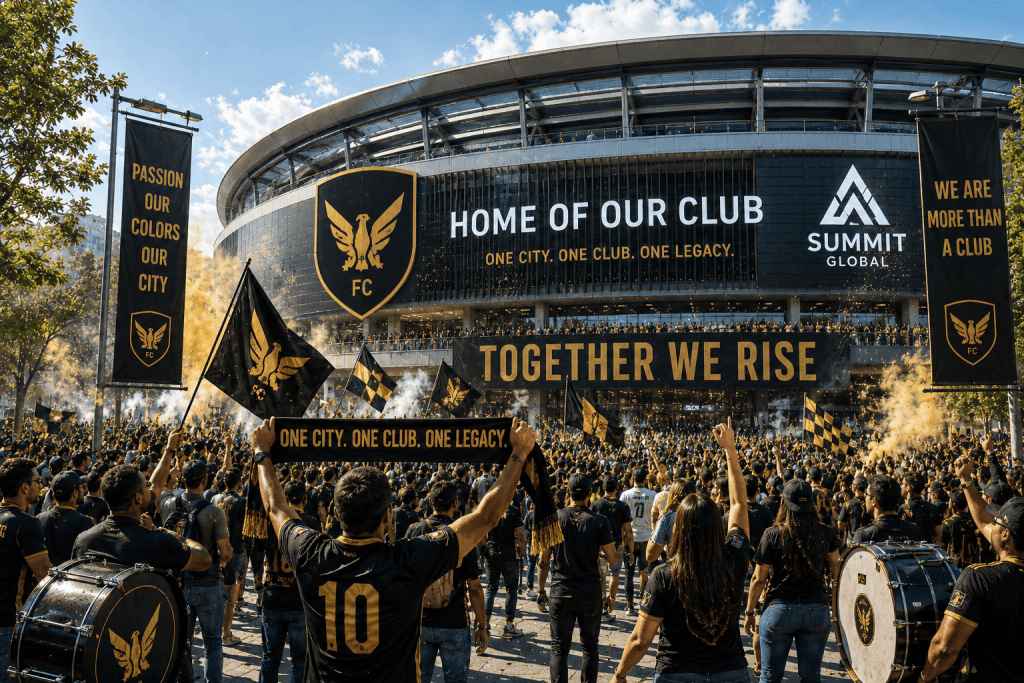
Football stadium naming rights have evolved far beyond traditional sponsorships. Modern agreements involving clubs like FC Barcelona, Manchester City, and MLS franchises increasingly operate as sophisticated commercial assets built around trademark licensing, exclusivity rights, media exposure, and intellectual property strategy.
As soccer continues expanding commercially across the United States — especially ahead of the 2026 FIFA World Cup — stadium naming rights are becoming increasingly valuable to brands, investors, and clubs seeking long-term commercial growth. From Chicago to Detroit to Miami, the intersection of sports, branding, and intellectual property law is rapidly reshaping the business of football (or soccer in the US).
Note: Because this article discusses both global football culture and the U.S. sports market, the terms “football” and “soccer” may be used interchangeably throughout.
1. Introduction
For decades, soccer stadiums represented geography, tradition, and club identity. Names like Old Trafford, Anfield, San Siro, and the Santiago Bernabéu carried emotional meaning that extended far beyond the physical venue itself.
But modern soccer has changed.
From the Emirates Stadium in London to Spotify Camp Nou in Barcelona and Allianz Arena in Munich, naming-rights agreements are reshaping the economics of soccer. These partnerships are no longer simple sponsorship deals focused only on visibility. Instead, they operate as long-term strategic assets that combine branding, intellectual property, media exposure, exclusivity rights, and commercial integration into fan culture.
With the growth of Major League Soccer (MLS), the arrival of global stars, the increasing influence of private investment, and the commercial momentum surrounding the 2026 FIFA World Cup, football clubs and venue operators are increasingly adopting sponsorship models long associated with American sports business.
This commercial evolution is becoming increasingly relevant in major American markets like Chicago and Detroit, where investment in sports, entertainment districts, hospitality, and mixed-use developments continues expanding alongside growing interest in professional soccer and international sporting events.
In this article, we explore why soccer stadium naming rights matter, how commercial strategy has changed across Europe and North America, and why these agreements increasingly function as sophisticated intellectual property and branding structures rather than traditional advertising partnerships.
2. Why Stadium Naming Rights Matter
Soccer (or football in other countries) is no longer only a sporting industry. It is a global entertainment economy. And stadium naming rights have become one of the most valuable tools within that commercial ecosystem.
For clubs, these agreements create predictable long-term revenue streams capable of funding:
- player acquisitions,
- stadium construction,
- infrastructure projects,
- academy development,
- and financial sustainability initiatives.
Related: Football Transfers Explained: A Practical Guide
For brands, the appeal is even larger. A stadium offers something traditional advertising cannot easily replicate: emotional integration into fan culture.
Unlike digital advertisements that disappear within seconds, stadium naming rights become part of everyday language. That repetition creates extraordinary commercial value.
3. Football Commercial Strategy Changed

Historically, European football clubs resisted corporate stadium naming more aggressively than American sports franchises.
Many traditional soccer stadium names were deeply connected to club identity and local history. Fans often viewed corporate renaming as commercialization at the expense of heritage. That tension between commercialization and tradition still exists today.
Over time, the economics of global soccer gradually softened that resistance. While tradition remains fundamental to many clubs and their supporters, fans have increasingly accepted stadium renaming when it delivers clear competitive benefits — stronger financial stability, better players, improved coaching, modern infrastructure, and ultimately a more competitive team on the pitch.
Naming-rights adoption also varies significantly by market. Germany’s Bundesliga has embraced stadium sponsorships at a much higher rate than many traditional English clubs, reflecting differences in commercial culture, ownership structures, and supporter expectations. By contrast, several historic clubs in England have faced stronger resistance from supporters seeking to preserve traditional stadium identities (Barca Innovation Hub).
Today, stadium naming rights are no longer limited to simple sponsorship agreements; they have evolved into powerful branding and media assets that connect football with finance, entertainment, technology, tourism, and global corporate strategy.
a. Naming Examples
Some of the most notable examples include:
- Etihad Stadium — Manchester City (England): The Etihad partnership became part of a broader investment strategy connecting soccer, aviation, tourism, and global soft-power branding.
- Signal Iduna Park — Borussia Dortmund (Germany): The agreement highlights the balance between commercialization and soccer tradition, as many supporters still refer to the stadium by its historic name, Westfalenstadion.
- Mercedes-Benz Stadium — Atlanta United (United States): The partnership demonstrates how luxury global brands use stadium naming rights to align themselves with premium entertainment experiences and major international sporting events.
- Hard Rock Stadium — Miami (United States): Hard Rock transformed the venue into a year-round entertainment platform hosting soccer, NFL games, Formula 1, concerts, and global events, illustrating how stadium branding increasingly intersects with tourism and lifestyle marketing.
- Red Bull Arena — New York Red Bulls / RB Leipzig / Red Bull Salzburg: Red Bull represents one of the most aggressive examples of sports brand integration, combining club ownership, stadium naming rights, and a unified global soccer marketing strategy.
- Neo Química Arena — Corinthians (Brazil): The agreement reflects how South American soccer clubs are increasingly adopting commercially sophisticated sponsorship models similar to those seen in Europe and North America.
- Inter&Co Stadium — Orlando City SC (United States)
The Brazilian digital banking company Inter&Co uses the partnership to expand its visibility in the U.S. market while connecting its brand with international soccer audiences ahead of the 2026 FIFA World Cup.
Related: The 2026 FIFA World Cup: What the Numbers Really Say
Together, these examples illustrate how stadium naming rights have evolved into globally integrated commercial assets tied to media exposure, trademark value, and long-term brand positioning.
4. Stadium Name As a Strategic Asset

At first glance, football stadium naming rights appear to be sponsorship agreements. In reality, they are far more sophisticated. These deals combine into a single integrated business asset:
- intellectual property law,
- trademark licensing,
- exclusivity rights,
- reputation management,
- media strategy,
- and long-term commercial positioning
Traditional advertising competes for attention. Stadium naming rights compete for association. Similar dynamics can be seen in college sports, where national exposure increasingly creates long-term commercial and branding opportunities for athletes and institutions.
Related: March Madness: From Exposure to Opportunity.
The objective is not merely visibility, but integration. The sponsor wants its brand to become part of how fans experience the club itself. Over time, the stadium name begins appearing continuously across:
- match broadcasts,
- streaming platforms,
- sports journalism,
- merchandise,
- social media,
- video games,
- ticketing systems,
- and global marketing campaigns.
In commercial terms, the stadium becomes a long-term trademark amplification platform.
The rapid expansion of stadium naming rights reflects a broader trend in football’s commercialization. Football Benchmark’s The European Elite 2025 report notes that commercial income now represents the primary revenue stream for elite European clubs, accounting for 43% of total operating revenue in 2025.
As clubs evolve into global media and entertainment brands, stadium naming rights have become increasingly valuable long-term commercial assets rather than simple sponsorship agreements.
A. Trademark Licensing and Brand Control
In many cases, the value of the agreement depends not only on visibility, but on maintaining consistent trademark association across broadcasts, digital platforms, merchandise, and international media coverage.
This level of exposure requires highly controlled trademark licensing structures. Most naming rights agreements regulate logo placement, typography, digital use, signage standards, sponsorship activations, and broadcast integration.
In other words, the stadium itself becomes part of the sponsor’s intellectual property strategy.
Related: College Sports Trademark Battles: From Rivalries to Courtrooms & Brand Control
B. Exclusivity Rights and Commercial Dominance
Sponsors often negotiate protections preventing competing brands from receiving comparable exposure inside the stadium or through affiliated partnerships.
For example:
- an airline sponsor may prohibit competing airlines from major advertising placements,
- a financial institution may block rival banking partnerships,
- or a technology company may restrict competing digital integrations.
The sponsor is not simply buying exposure. It is purchasing protected commercial territory within one of the most emotionally powerful environments in global entertainment. From a business and intellectual property perspective, these agreements increasingly resemble long-term brand licensing and media-distribution arrangements rather than traditional advertising contracts.
C. Reputation Management and Long-Term Risk
Because these agreements often last decades, they also involve significant reputational and legal risk management. Modern contracts increasingly include morality clauses allowing termination if either party becomes associated with:
- scandal,
- criminal conduct,
- financial collapse,
- or reputational harm.
This issue became especially visible following the instability of several cryptocurrency sponsorship deals, where rapid changes in public trust dramatically affected the perceived value of sports partnerships.
D. Intellectual Property Enforcement
The value of a stadium naming agreement depends heavily on maintaining exclusivity and trademark control. As a result, companies investing millions into football stadium naming rights must actively monitor:
- counterfeit merchandise,
- unauthorized commercial references,
- ambush marketing campaigns,
- and confusingly similar branding.
That is why these agreements ultimately operate as much through intellectual property strategy as through sports marketing itself.
5. Conclusion
The rise of stadium naming rights reflects the broader transformation of football into a global commercial ecosystem. Modern clubs are no longer only sporting institutions; they are international entertainment brands competing for media attention, sponsorship revenue, global audiences, and long-term enterprise value.
For clubs, naming-rights agreements create stable revenue streams capable of funding stadium construction, player acquisitions, infrastructure development, and long-term competitiveness. For corporations, they provide something far more valuable than traditional advertising: permanent integration into the emotional identity and daily language of millions of supporters worldwide.
At the same time, these agreements increasingly depend on sophisticated legal and commercial structures involving trademark licensing, exclusivity protections, reputation management, and intellectual property enforcement. The stadium itself becomes a strategic media asset capable of generating global visibility across broadcasts, streaming platforms, merchandise, social media, and digital ecosystems.
As football continues expanding commercially — especially with the growth of MLS and the approach of the 2026 FIFA World Cup — stadium naming rights will likely become even more valuable.
What once appeared to be a simple sponsorship opportunity has evolved into a sophisticated commercial ecosystem where branding, media rights, intellectual property, and global sports business increasingly intersect.
ABOUT THE AUTHOR
Alexander R. Karana is an intellectual property and international attorney at Cummings, McClorey, Davis & Acho, PLC (CMDA), admitted to practice in Michigan, Illinois, and before the United States Patent and Trademark Office. He focuses on patent and trademark prosecution, IP strategy, and entertainment law. Alexander has been recognized by Best Lawyers: Ones to Watch in America and Super Lawyers: Rising Stars for his work in IP and sports & entertainment law.
EMAIL ALEXANDER
His practice includes intellectual property law with a focus on patent and trademark prosecution, IP litigation, and brand protection strategies, as well as business transactions and contract drafting and negotiation. He regularly advises clients on patent applications, trademark clearance and registration, licensing agreements, infringement and enforcement matters, and technology-related legal issues. His practice also extends to sports and entertainment law, including name, image, and likeness (NIL) matters, where he represents athletes, entertainers, and content creators in business negotiations, endorsement and sponsorship agreements, and related disputes and litigation.
Alexander helps inventors, entrepreneurs, and online brands protect and monetize innovation through patent and trademark prosecution, strategic IP enforcement, and commercial transactions.
Contact: akarana@cmda-law.com | 17436 College Parkway, Livonia, MI 48152
Legal Disclaimer: This article is for informational purposes only and does not constitute legal advice. Reading it or contacting the author does not create an attorney-client relationship. Each case is unique; consult a qualified attorney for your specific situation.